Alright Vikings, Grab Your Axes – Valheim Patch 0.220.5 is Here
Alright Vikings, grab your axes and pour yourselves a horn of mead! Iron Gate just dropped another update for Valheim, patch 0.220.5. While it might seem like just another number on the long road to the Ashlands, these little patches often bring neat fixes—and sometimes, they tweak things around our favorite wandering merchant, Haldor. Let’s dive in and see what’s cooking in the tenth realm, especially concerning the blue dwarf with the best loot (and the only loot you can buy, really).
Valheim Patch 0.220.5 Arrives: More Than Just Bug Squashing?
Valheim patches usually fall into a few categories: big content drops, mid-size updates with new mechanics or mini-biomes, and these smaller, numbered patches. Patch 0.220.5 looks like it fits into that last category—focusing on stability, bug fixes, performance tweaks, and balance adjustments.
These patches often include:
Bug fixes (e.g., flying carts, terrain issues)
Networking improvements for smoother multiplayer
Enemy AI tweaks
Building system fixes
They may be small, but the impact on gameplay is meaningful. Think fewer crashes, smoother framerates, and less frustration. But one question often rises above the rest…
Haldor the Trader: Still Rocking the Blue Hue in 0.220.5?
Haldor, the blue-skinned merchant in the Black Forest, is a milestone for all Valheim players. His offerings are game-changing:
Megingjord: Increases carry weight from 300 to 450 for 950 Coins.
Ymir Flesh: Required for crafting the Iron Sledge and Frostner.
Dverger Circlet: A headlamp for dungeon exploring (620 Coins).
Fishing Rod & Bait: Basic angling gear.
Thunder Stone: Needed to craft the Obliterator (item disposal).
Yule Hat: A cosmetic seasonal item. Fashion matters!
What Could Patch 0.220.5 Change About Haldor?
No confirmed changes, but here’s what might have happened behind the scenes:
Spawn Fixes: Ensuring Haldor appears in valid Black Forest areas.
Interaction Bugs: Fixing trade windows or unresponsive dialogues.
Dialogue Tweaks: Possible lore hints or new one-liners.
Item Price Adjustments: Small economy tweaks (bait, treasure values).
Bubble Fixes: Reinforcing his force field from bugged mob attacks.
Map Icon Fixes: Making his location marker more reliable.
Most likely: bug fixes related to his functionality and spawn logic.
The Wider Impact of 0.220.5
Beyond Haldor, this patch likely includes:
Performance & Optimization: Better framerates, faster loading, and improved LODs.
Building System Improvements: Fixes to snap points, structural physics, or render bugs.
Combat Balancing: Small tweaks to stamina, damage values, or enemy AI behavior.
Multiplayer Stability: Desync fixes, smoother inventory sharing, reliable boss fights.
World Generation Fixes: No more floating copper nodes or invisible terrain holes.
It’s all about polish. You may not notice a dramatic change, but the experience gets smoother.
Keep Calm and Keep Viking On
Should you go find Haldor immediately because of this patch? Probably not—unless you had a bug that made him impossible to find. But this is a great excuse to hop back into Valheim regardless.
Check if your favorite mods still work, gather your friends, and set sail again. Whether you’re returning to defeat the next boss or just building your next mead hall, the tenth realm awaits—with fewer bugs and smoother sailing. Skål!
Valheim patch 0.221.4 (Public Test) is live with adrenaline adjustments, wooden weapon fixes, and a proper name restore for T.W.I.G. This roundup covers access steps, key highlights, and the detailed fixes so you can decide when to hop into the branch—just remember to back up your worlds.
Weapons & crafting: Skull Splittur craftable at Black Forge lvl 1; now emits light; Blackmetal Battleaxe/Skull Splittur grip corrected; trinkets move to Forge/Black Forge.
Projectile tweaks: Frost Blob weak to fire, resistant to frost; Frost Blob Bomb uses Drake trophy; Staff of Frost grants 1 adrenaline per hit.
Creatures: bears swim; Viles in Plains Monster faction; Viles can drop Rotten Meat; both despawn in 4s and path around trees/boulders.
World & items: stairs on Stone Portal climbable; cores no longer forced into hotbar; Fader sacrificial stone carvings brighter; Bearskin Rug flicker fixed.
Placement & stands: Fragrant Bundle, Fresh Seaweed, Thistle place flat on stands (shift+E rotates).
Quality-of-life: overencumbered players can’t dodge; trinket + utility item both visible on character; Stone Portal stairs climbable.
Stability: shield generator projectile exceptions fixed; sledges hit fractured mine rocks again; T.W.I.G. no longer deconstructs multiple times in multiplayer.
Matchmaking/UI: join-code server add now refreshes immediately.
Risks and spoiler courtesy
Public Test may be unstable—keep backups.
Avoid posting spoilers where players aren’t opted in; keep feedback to official channels.
For more Valheim coverage and build guides, browse the Valheim category and switch back to default once the patch graduates if you prefer stability.
The Viking survival sensation, Valheim, has captivated players with its unique blend of exploration, crafting, and challenging combat. However, the journey through the Norse afterlife is far from over, and many players are eagerly anticipating what the future holds. While the recent Ashlands update brought a fiery new biome to explore, the question on many Vikings’ minds is: what’s next, and when can we expect it? This article dives into the known details of Valheim’s development roadmap, specifically focusing on what we might expect in 2025 and beyond. If you are planning Ashlands runs with friends, a Valheim server hosting setup keeps your world stable between updates.
Valheim’s Update Cycle: A Slow Burn
Since its early access release in 2021, Valheim has seen several major updates, each adding significant content and expanding the game’s world. While the developers at Iron Gate have consistently delivered quality updates, the time between them can be substantial. The most recent major update, the Ashlands, was released in May 2024, roughly 1.5 years after the Mistlands update in December 2022. This slow update cycle has led to a decline in player numbers after the game’s initial surge in popularity.
The wait between updates is a common point of contention among Valheim players. While the developers consistently release minor patches and quality-of-life improvements, the gaps between major content additions can feel lengthy. As players eagerly anticipate new challenges and areas to explore, the protracted wait can lead to a sense of stagnation.
The Deep North: A Long-Awaited Update
The next major biome update for Valheim is the Deep North, which is also expected to coincide with the game’s official 1.0 release. The Deep North is the final biome currently planned and is anticipated to bring a significant amount of new content. This update is particularly important as it will mark the end of Valheim’s Early Access period, which suggests the developers are aiming for a grand finale. However, this ambition might also mean a longer wait than players might expect.
Currently, there is no official release date for the Deep North update. Given the development time between the Mistlands and Ashlands updates, it’s likely that the Deep North may not arrive until late 2025 or even sometime in 2026. Iron Gate’s lead artist, Robin Eyre, stated in an interview with Eurogamer that they want the Deep North to “feel like an actual 1.0 release,” implying that it will include significant upgrades and improvements across the game, not just in the new biome itself.
Valheim’s Future: More Than Just a New Biome
Expanded Building Options: The building system is one of Valheim’s core mechanics and there is always more room for improvement. We might see a wider range of building materials, shapes, and mechanics that allow players to create more diverse and elaborate structures.
Enhanced Combat: The combat system, while engaging, could benefit from further refinements. This could potentially include new weapons, enemy types, and perhaps even tweaks to the existing combat mechanics.
Improved Quality of Life: QoL improvements have been a staple of Valheim’s updates, and the 1.0 release is unlikely to be an exception. We might see a more user-friendly interface, changes to inventory management, and other tweaks that will improve the overall user experience.
New Boss Encounters: Every new biome typically introduces a new challenging boss, and the Deep North is unlikely to be an exception. Players can expect a formidable new foe to test their Viking skills.
Story Progression: While Valheim has a light narrative, the 1.0 release might offer a more cohesive storyline, providing greater context to the player’s journey.
The Player Base: Waiting with Bated Breath
The slow update schedule has had an impact on Valheim’s player base. After peaking at around 400,000 concurrent players on Steam at launch, the numbers have dropped significantly, often hovering around or below 30,000. This decline is not uncommon for early access games, but the extended wait for new content does contribute to the decreased engagement.
A Resurgence in the Viking Afterlife
The wait for the Deep North update may seem daunting, but there are good reasons to remain optimistic about Valheim’s future. The developers have consistently demonstrated their commitment to quality, and the 1.0 release is likely to mark a new chapter for the game. As seen with other early access successes like Baldur’s Gate 3, a significant surge in popularity can occur when the game exits early access. This is exactly what Valheim developers will be hoping for.
Valheim Seed Viewer: Finding the Perfect World for Your Viking Saga
So, you’re hooked on Valheim, huh? Sailing the seas, battling trolls, building epic longhouses – it’s all awesome.
But let’s be real, the world you spawn into can make or break your Viking experience. Sometimes you’re stuck with
a swampy start, or maybe the boss locations are just plain awful. That’s where a Valheim seed viewer comes in clutch.
What is a Seed?
Think of it like a blueprint for your Valheim world. It’s a string of numbers that the game uses to generate the
entire landscape, from the placement of mountains to the location of dungeons and resources. Every world has its
unique seed. If you know that seed, you can recreate that world exactly, or, with a viewer, you can peek at what
awaits you before committing to a playthrough.
Why Use a Seed Viewer?
Using a seed viewer offers a ton of advantages:
Finding the Perfect Start: Scout islands with convenient access to multiple biomes for early resource gathering and quick progression.
Boss Location Intel: Know where bosses are located to save time and plan hunts efficiently.
Resource Hunting: Locate specific biomes for resources to craft weapons or armor.
Portals Made Easy: Plan the best places for portals to minimize travel time.
World Customization: Avoid unwanted biomes or ensure access to essential ones.
How Do Seed Viewers Work?
A Valheim seed viewer processes the game’s data to visually map out the world. These viewers usually show:
Biome locations
Boss spawn locations
Resource locations
Overall map layout
Finding the Right Seed Viewer
Search for “Valheim seed viewer” to find reliable tools that are updated with the latest game versions.
Using a Seed Viewer: Step-by-Step
Find a Seed Viewer Website: Pick a reliable site.
Enter Your Seed: Use the “generate random” function or input your world’s seed. Press F5 in the game, type seed, and press Enter to find your seed.
Explore the Map: Pan and zoom to view the world.
Note the Information: Focus on key areas like starting location, boss spawns, and resource-rich zones.
Start Your Game: Enter the seed manually when creating a new world.
Seed Viewer Tips and Tricks
Don’t Spoil Everything: Use the viewer for general planning, not for uncovering every secret.
Experiment: Try different seeds for unique worlds.
Community Seeds: Check out recommended seeds shared by the Valheim community.
Stay Updated: Ensure your seed viewer is compatible with the latest game version.
Beyond the Basics
Using a Valheim seed viewer can help you get to the fun parts of the game faster, making it perfect for players of all
experience levels. Instead of spending hours searching, you can jump right into building and exploring with your friends.
Ready to take your Valheim experience to the next level? Give a seed viewer a try and find the perfect world for your legend!
Valheim
Server Hosting – Fast, Modded, Crossplay Servers
Choose our Valheim
server hosting for a seamless co-op grind. We pre-install BepInEx with curated 1-click mod profiles,
ship Xbox + PC crossplay configs out of the box, and run everything on fast, DDoS-protected hardware
with 99.9% uptime.
Cheap Valheim Server Hosting Prices
Start from flexible S/M/L plans with uncapped RAM and disk, static IPs, and branding-free servers.
Your custom admin panel, FTP/RCON, and 2-day refund policy keep costs predictable while you test
worlds risk-free.
Modded Valheim Servers with BepInEx & 1-Click Mods
Swap between popular modpacks, roll back changes quickly, and lean on our support team for broken
mods or config tweaks. There’s also a free Satisfactory server bundle for Valheim
customers—double up on survival without extra spend.
Our Valheim dedicated server hosting pre-installs BepInEx, supports CustomSeed, and exposes
preset/modifier options in the panel. If you bring your own mods, upload them via FTP or the file
manager and restart from the panel.
Steam&Consoles
Powerful Hardware
BepInEx and 1-click Mods
User Friendly Panel
FTP&Rcon
Static IP
Addresses
Branding-Free Servers
Uncapped RAM
Uncapped disk space
Custom Admin Panel
Great Support
2-Day Refund Policy
PROMO: Buy Valheim - get access to Palworld, Satisfactory, Factorio & 8 more games. See all games
Step 1
Pick a plan
Choose based on player count and mod load.
Step 2
Launch instantly
We provision your server with clean configs.
Step 3
Invite your crew
Share the IP and scale later without wipes.
“Mods worked first try, and the server stayed smooth all night.”
Valheim customer review
2-Day Money-Back Guarantee
Safe Payments
Available regions: US West (Oregon), US East (Virginia), US North-East (Toronto), Europe West (Paris), Australia (Sydney)
Plan S
$799
/ per month
Up to 5 Players
CPU Priority
3
Steam & consoles
Mods
Maps seeds
Game import/export
Beta/unstable versions
The gameplay on the server is optimized to run smoothly on a non-modded server. For those who are looking for a solid, stable basic hosting for a small team.
Plan M
$1299
/ per month
Up to 10 Players
CPU Priority
2
Steam & consoles
Mods
Maps seeds
Game import/export
Beta/unstable versions
At a great price, you receive a fast and stable server. Configuration is ready for moderate server modding. For most players, this is the best option.
Plan L
$2499
/ per month
Up to 30 Players
CPU Priority
1
Steam & consoles
Mods
Maps seeds
Game upload/download
Beta/unstable versions
The ideal option for larger teams and experienced modders.
With this plan you can go beyond standard players limit and run heavy mods.
Great hosting service, I've been renting from them for 4 months now with no issues. Have yet to try using mods on my server but I did use Darkness Falls for a month and had no issues. Highly recommend.
C
Customer
This host is probably the best host I ever had there is nothing to say bad about them the only suggestion I have if u could add support for server tools in the future that will probably make the best host on the market for 7dtd with out question, thank you .Never run out of resources.
Ilie Scodrea
Enjoy smooth, lag-free Valheim gameplay by hosting your dedicated server with Supercraft.
With us, you’re not just renting a server – you’re getting a reliable partner for your
Valheim adventures.
Our high-performance infrastructure delivers fast, stable worlds so you can focus on exploring,
building, and fighting in Valheim’s vast Norse-inspired universe.
Enjoy seamless gameplay with our
99.9% uptime guarantee
and robust security to keep your realm safe.
Our user-friendly control panel and responsive support team make server
management easy. Customize your Valheim server, install mods, manage backups, and tweak settings in just a few clicks.
Whether you run a small Viking clan or a 30-player community, Supercraft gives you a reliable, hassle-free
Valheim hosting solution.
Valheim Server Hosting FAQ
We currently offer Valheim servers in the following regions: US West (Oregon), US East (Virginia), US North-East (Toronto), Europe West (Paris), and Australia (Sydney).
RAM and storage are not hard-capped. Server processes receive priority according to the plan you choose.
Yes. You can upload your Valheim world either via the File Manager in the admin panel or via FTP.
Yes. By setting a server password, you can protect your Valheim server.
Players will need to enter the password to join.
Our Valheim server plans can support up to 30 players.
You can change your server name, welcome message, public/private visibility, password, crossplay options,
user config, gameplay settings, and more via your custom Valheim server web interface.
Yes. We support modded Valheim servers, including popular mod frameworks like BepInEx.
Yes. You can make your Valheim server private by adding a password in your server options.
Only players with the password will be able to join.
You can host your own Valheim server, but it’s often complicated and time-consuming.
With Supercraft you get an optimized dedicated server instantly.
If you still want to try hosting it yourself, here’s a quick setup guide:
Valheim Dedicated Server Setup Guide
Minimum System Requirements
Quad-core processor
At least 2 GB RAM
Minimum 2 GB available storage space
Supported OS: Linux (Ubuntu 16.04+), Windows 7/8/10 (64-bit), Windows Server 2012–2022
Note: Servers with mods may require more processing power.
We tune Valheim servers for steady tick rates during raids, base builds, and Mistlands
exploration. NVMe storage and Ryzen CPUs keep save writes quick, while snapshots let you roll back before
a corrupted mod, griefing, or accidental world wipe.
Crossplay is preconfigured for Xbox and PC, and our panel ships with BepInEx + 1-click mod
profiles. Upload your own mod list via FTP, restart from the panel, and keep configs versioned so you can
revert bad updates.
Migrate without friction: upload your existing world, apply your passwords and admin list,
and invite your clan back within minutes. If you need help, send us your modpack and we’ll align versions
for you.
FAQ
Yes. Crossplay configs are included so Xbox and Steam players can join the same
world without extra setup.
BepInEx is pre-installed, with 1-click mod profiles. Upload custom mods via FTP,
restart, and roll back easily with snapshots if a mod breaks.
Yes. Upload your .db/.fwl files, restart, and keep passwords, admin lists, and
progress intact. We’ll help align mod versions if needed.
US West (Oregon), US East (Virginia), US North-East (Toronto), Europe West (Paris), and Australia (Sydney) today. Move regions without wiping your
save.
Yes. In My Account → Subscriptions, you can upgrade to a higher Valheim tier
with the same billing cadence (for example, monthly to monthly). Downgrades are not available right now.
During an upgrade, your deployment is updated in place (quota update + restart), not wiped and recreated.
Create a folder, then install:
steamcmd +login anonymous +force_install_dir ~/valheim +app_update 896660 validate +quit
Edit start_server.sh with your world name, password, and public/private setting.
Forward ports 2456-2458 UDP and run the script. Watch logs for connection errors.
It works—but you lose managed backups, DDoS protection, and 1-click mods, which is why most teams prefer
hosted Valheim servers.
Use our configuration panel or edit files directly. See our complete Valheim Server Configuration Guide for all available settings, world parameters, and server options.
Average Valheim server hosting cost is around $10-$16 per month for small clans.
Dedicated server cost trends higher as RAM/CPU needs grow with large builds, raids, mod packs, storage I/O for backups,
and higher player slots, plus bandwidth, DDoS protection, and admin tooling.
It’s easy to get started
Follow these quick steps to launch your dedicated game server with Supercraft.
1
Choose your plan
Select the best option for your needs
2
Create account
Or login if you have one
3
Make payment
Choose one of our secured payment methods
4
Select your region
Choose the closest location for the lowest ping
5
Install the game
Game will run automatically after installation
6
Connect!
You will have the port and IP in the management panel
Valheim Teleportation and Time Management: Portal Tips for Busy Players
Short on time but still want to raid, build, and explore? This Valheim teleportation guide shows how to set up portals, handle metal runs, and tweak settings so you spend less time hauling and more time having fun.
When to enable unrestricted teleportation
Portal layout ideas to cut travel time
Pros and cons of skipping long resource hauls
Valheim teleportation basics
By default, Valheim blocks metals through portals to push exploration and logistics. If you’re replaying or have limited gaming windows, turning on unrestricted teleportation (or using a QoL mod in single-player) lets you move ore and bars through portals without long boat trips.
Portal setup for time savings
Hub-and-spoke: Build a main portal room at base; label portals to key biomes (Meadows, Swamp, Mountain, Plains).
Resource outposts: Drop a portal at copper/tin/silver nodes so you can return quickly for multiple runs.
Boss routes: Park portals near boss altars to save prep time for retries.
Fuel and safety: Keep surtling cores and fine wood in a chest at the hub for quick replacements if a portal breaks.
Managing metals with or without restrictions
Vanilla rules: Use carts and longships for immersion; combine portal hops with short boat legs to reduce risk.
Unrestricted mode: Portal ores/bars straight home; this is great for parents, co-op nights, or late-game replays.
Compromise: Allow ore teleport for early metals only, but sail black metal for danger and adventure.
Time-management tweaks beyond portals
Boost yields: Adjust resource rates on private servers to cut grind.
Pre-stage kits: Keep spare armor, food, and arrows near boss portals.
Task batching: Chain smelting/charcoal/kiln cycles between short play sessions.
Should you loosen teleport limits?
Pros: faster progression, less backtracking, and easier co-op scheduling. Cons: fewer boat encounters and less emergent travel moments. Choose the approach that matches your current playthrough—strict for first runs, relaxed for time-crunched or repeat runs.
Want a smooth server while you portal-hop? Check our Valheim server hosting guide to keep sessions stable for friends and family.
Valheim Updates: Deep North, Combat Enhancements, and More
Valheim’s developers have shared exciting news in their latest update, “Word From the Devs: Mystery Foes.” Here’s an in-depth look at what’s coming to Valheim:
Introducing “Word From the Devs”
The monthly blog posts are now titled “Word From the Devs,” replacing the previous “Development Blog” name. This change aims to better reflect the content and updates shared with the community.
Deep North Biome Development
Work on the mysterious Deep North biome is underway. While details are scarce to preserve the element of discovery, the developers have hinted at intriguing content awaiting players brave enough to explore this frozen expanse.
Upcoming Combat Update
Before the Deep North release, a smaller update focusing on combat mechanics is planned. Notably, this update will address the long-standing issue of fighting on slopes, enhancing the overall combat experience.
New Armor Teased
Alongside combat improvements, new armor is on the horizon. A sneak peek was shared on Instagram, sparking speculation about the creature it’s crafted from. Stay tuned for more details!
Community Spotlight: Fort Elvetham, a stunning build by kpthe13th and his daughters, is featured as this month’s “Build of the Month.” Share your creations using #ValheimBotM for a chance to be highlighted.
Rocky Plushie Update
Thanks to everyone who supported the Makeship campaign for the Rocky plushie! Shipments are expected in August 2025. Keep an eye out for updates.
For more information and discussions, join the Valheim community on Discord or visit the Reddit forums.
Sharpen your swords and prepare for new adventures!
Valheim vs Ark: Survival Evolved vs Satisfactory – Hosting on a Dedicated Server
For gaming enthusiasts looking to dive into server hosting, choosing the right game to host can be as crucial as the gameplay itself. Popular titles like Valheim, Ark: Survival Evolved, and Satisfactory each come with their unique server demands. This guide will delve into the technicalities of hosting a dedicated server for each of these games, providing insights for those who consider setting up their own gaming server.
Valheim: Managing a Norse World
Valheim might seem less resource-intensive compared to Ark, but it still poses unique challenges for server hosting.
Optimal Server Specs: For smooth operation, a dedicated server for Valheim should have at least 4 CPU cores, 8GB RAM, and a high-speed SSD. As the player count and world size increase, scaling up the server’s CPU and RAM becomes necessary to prevent lag.
Network Bandwidth: Given its multiplayer nature, sufficient network bandwidth is crucial to handle the data flow, especially with near-maximum player capacity.
Data Integrity and Backups: Regular backups are essential. Implement automated backup systems to protect against data loss. It’s also wise to use RAID configurations for added data redundancy.
Ark: Survival Evolved – A Resource-Heavy Endeavor
Hosting Ark: Survival Evolved is a demanding task, requiring high-end server resources for optimal performance.
Hardware Requirements: A powerful server is non-negotiable. Ideally, a dedicated Ark server should have a multi-core CPU (preferably Ryzen or Xeon), at least 16GB of RAM, and an SSD for faster data access and loading times.
Advanced Server Configuration: Deep customization options mean you’ll need to be comfortable tweaking server settings, including dino spawn rates, day/night cycles, and player stats. Understanding how these settings impact server load is crucial.
Maintenance and Updates: Regular server maintenance, including updates and mod management, is necessary. Automating these processes where possible can save time and prevent server downtime.
Satisfactory: Hosting an Expanding Factory
Satisfactory, while less demanding in player count, requires attention to detail in server hosting as your factory grows in complexity.
Scaling with Factory Size: Start with a server that has at least 4 CPU cores and 8GB RAM, but be ready to scale up as your factory expands.
Persistent Server Connection: A stable and fast internet connection is crucial, with low latency being a priority to ensure real-time updates are seamless.
Automated Monitoring Tools: Use server monitoring tools to keep track of server health, CPU, and memory usage. This will help in proactively managing any potential issues.
General Hosting Considerations
Choosing a Hosting Provider: Look for a provider that offers high uptime, good customer support, and the flexibility to scale resources.
Security Measures: Implement robust security measures, including firewalls and DDoS protection, to safeguard your server.
Community Tools: For larger communities, incorporate community management tools for moderation, communication, and event planning.
In conclusion, hosting a dedicated server for Valheim, Ark, or Satisfactory requires a balance between understanding each game’s technical demands and preparing for continuous server management and maintenance. Your choice depends on the level of technical involvement you’re willing to invest in, alongside the unique gameplay experience each game offers.
Valheim vs Ark: Survival Evolved – A Guide to Choosing Your Survival Adventure
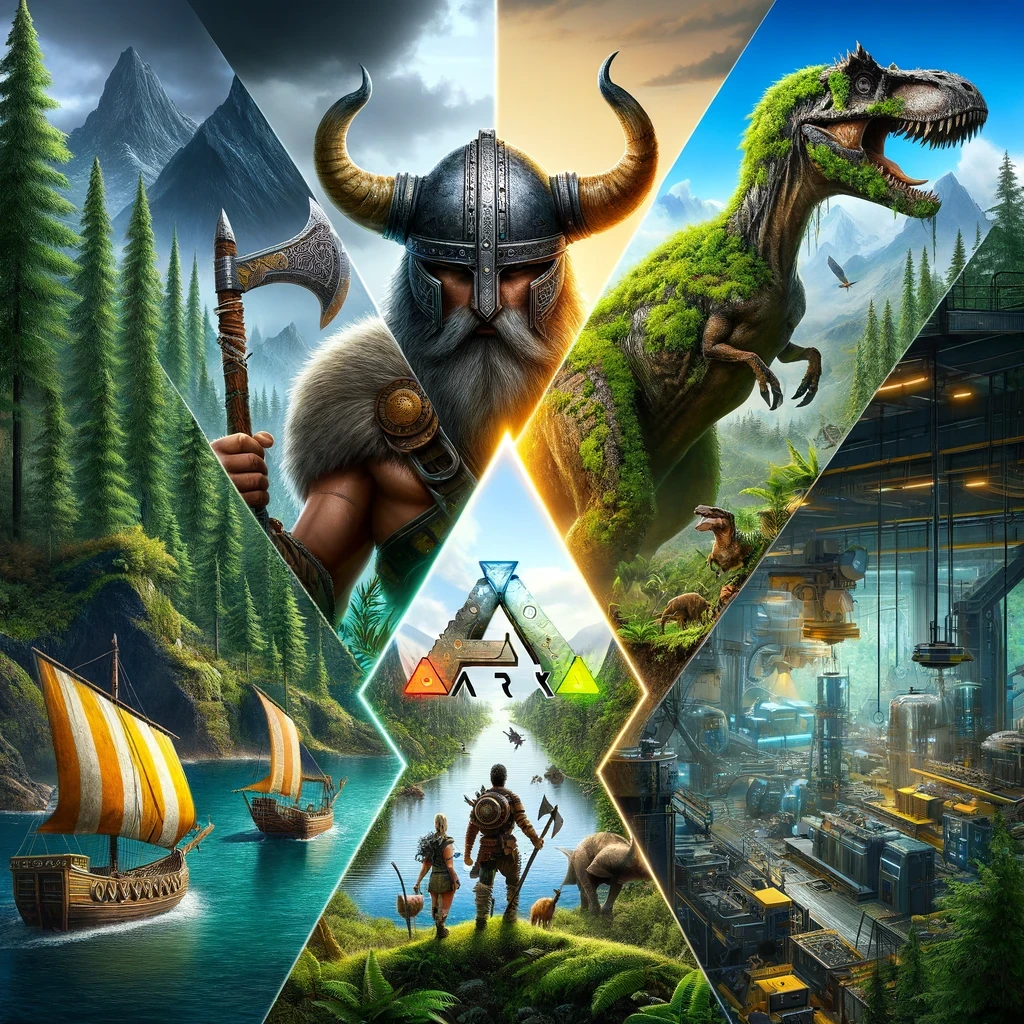
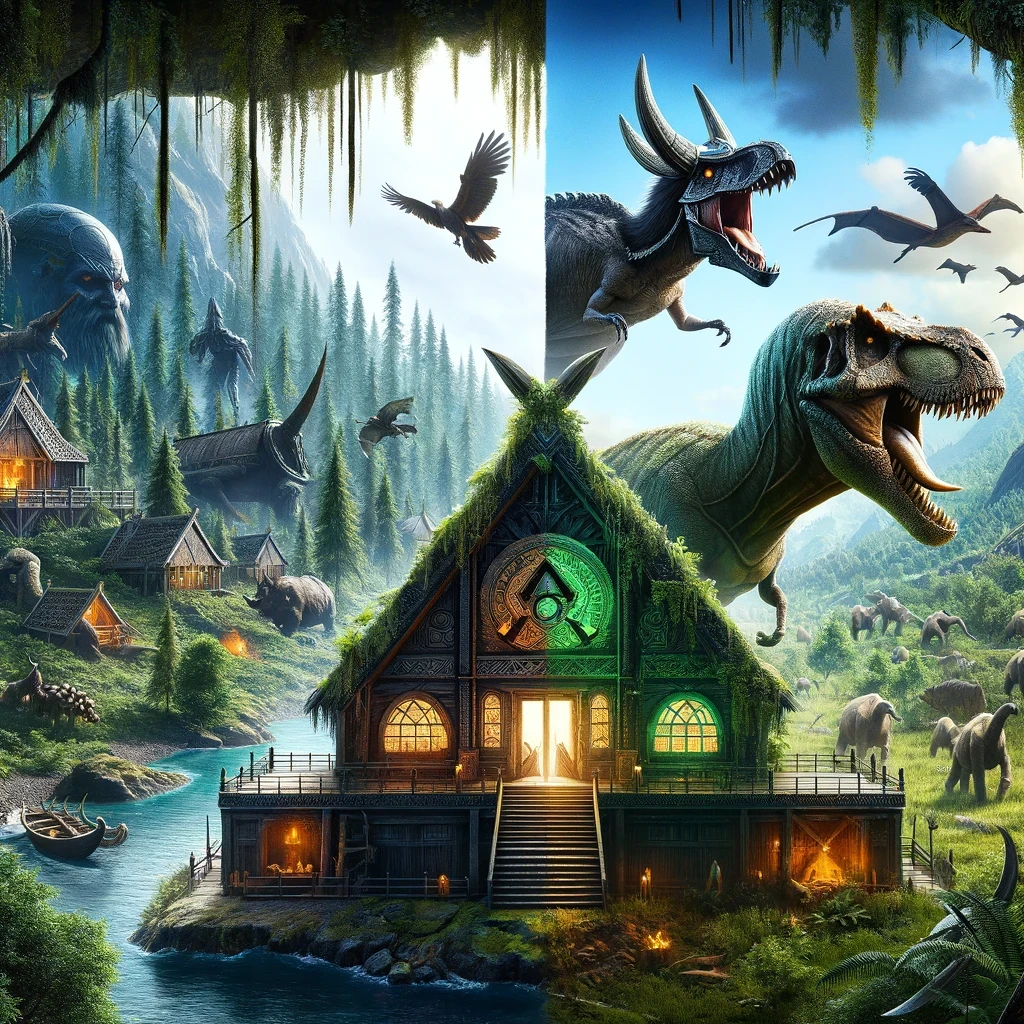
As avid gamers, we’re often faced with the delightful dilemma of choosing between two great games, especially when they belong to the same genre but offer unique experiences. Today, we’re diving deep into the world of survival games, pitting the mythological Norse world of Valheim against the prehistoric and sci-fi fusion of Ark: Survival Evolved. Both games have captivated players worldwide, but they cater to different tastes within the survival genre.
The Setting: Mythology vs Prehistory
Valheim transports you to a vast, procedurally generated world inspired by Norse mythology. You’re a Viking warrior tasked with proving your worth to enter Valhalla. The environment is rich in Scandinavian folklore, from mystical forests to daunting mountains.
On the other hand, Ark: Survival Evolved drops you, quite literally, into a mysterious island teeming with dinosaurs and other prehistoric creatures. This game blends the ancient with the futuristic, as you discover that you’re part of a larger, sci-fi mystery.
Gameplay Mechanics: Survival in Different Flavors
Both games thrive on the core survival mechanics of gathering resources, building shelters, and crafting tools. However, the approach differs significantly.
In Valheim, the focus is more on exploration and PvE (Player vs Environment) combat. You’ll spend time crafting Viking-era weapons, sailing to explore new lands, and fighting mythical beasts. The game’s combat is more grounded and strategic, requiring careful planning and execution.
Ark, meanwhile, emphasizes taming and riding dinosaurs, which adds a unique twist to its gameplay. Combat can be fast-paced and frantic, especially when dealing with aggressive dinosaurs or other players in PvP (Player vs Player) modes. Crafting in Ark is also more diversified, thanks to its tech tree that spans from primitive stone tools to high-tech gadgets.
Multiplayer Experience: Vikings vs Dinosaur Tamers
Valheim shines in its cooperative multiplayer aspect. It’s designed to be played with friends, where you can work together to build settlements and take down bosses. The environment is challenging yet less hostile, making it more about enjoying the journey together.
Ark’s multiplayer is more competitive and can be unforgiving. Players often have to contend with not just the environment and creatures but also other players. Building bases, raiding others, and surviving in a dynamically hostile world make for an intense multiplayer experience.
Graphics and Performance: Stylized vs Realistic
Valheim adopts a more stylized, low-poly graphic style which gives it a unique charm without demanding too much from your PC. Its environments are beautifully designed, offering a sense of serenity amidst the survival challenge.
Ark goes for a more realistic look, with detailed environments and creatures. This can make it more demanding on your system, but for those with the hardware to support it, Ark offers visually stunning landscapes filled with lifelike dinosaurs and lush jungles.
Choose Your Adventure
In conclusion, your choice between Valheim and Ark: Survival Evolved depends on what you seek in a survival game. If you prefer a more relaxed, exploration-focused experience with a mythological twist, Valheim is your go-to. But if you’re after a game that offers high-octane survival with dinosaurs and a mix of primitive and futuristic technology, then Ark will not disappoint.
Both games promise hours of engaging gameplay, challenging survival mechanics, and unique worlds to explore. Whichever you choose, prepare to embark on an unforgettable adventure in the world of survival gaming.
Valheim: 50+ Tips to Conquer the Viking Wasteland (No Spoilers, Promise!)
50 Valheim Tips to Conquer the Viking Wasteland (No Spoilers, Promise!)
So, you’ve just landed in Valheim, huh? Fresh off the boat (or, you know, the raven), ready to carve out your legend? Well, buckle up, buttercup, because this ain’t your grandma’s crafting game. Valheim’s a beast, and it’s about to chew you up and spit you out if you’re not careful. But don’t worry, I’ve got your back. Here are 50+ tips to get you from zero to Viking hero without spoiling the juicy bits. Let’s dive in!
Early Game Shenanigans: Don’t Be a Noob
Timber Trouble: Chopping trees early on can be a real pain in the ass. Those logs have a serious hate-on for your skull. Watch where they fall, or you’ll be eating dirt faster than you can say \”Valhalla!\”
Rock On: Smash those rocks! You’ll need stone for crafting, and it’s way easier than dealing with those tree-hugging maniacs.
Berry Bonanza: Gather all the berries you can find. They’re your early-game lifesavers when you’re low on health.
Mushrooms, too!: Keep an eye out for mushrooms. They’re another good food source, and variety is the spice of life (and your health bar).
Crafting is King: Start crafting immediately. Even the most basic tools will make your life significantly easier.
Build a Workbench: This is your crafting hub. Place it somewhere safe and convenient.
Hammer Time: Once you have a workbench, build a hammer. It’s essential for constructing buildings.
The Hut Must Stand: Construct a basic hut. It’ll provide shelter from the elements and keep you from freezing your Viking butt off.
Beddy-bye: Place a bed in your hut. This is your spawn point. If you die (and you will), you’ll respawn here.
Fire Starter: Don’t forget to make a campfire! It’s crucial for cooking food and staying warm.
Cooked Food is King: Raw food doesn’t do much for you. Cook everything you find over a fire for maximum health benefits.
Deer Hunting 101: Hunt those deer for leather and meat. They’re a great source of early-game resources.
Sneak Attack: Use the sneak ability to get the drop on unsuspecting deer. It’s much easier than a head-on confrontation.
Flint is Your Friend: Keep your eyes peeled for flint along the shoreline. It’s used to make better tools.
Stone Axe FTW: Upgrade to a stone axe as soon as you can. It’ll make chopping trees much more efficient.
Don’t be a Pack Mule: Avoid carrying too much. Overburdening slows you down significantly.
Stamina Matters: Keep an eye on your stamina. You don’t want to run out of steam mid-fight.
Rest Up: Resting in your hut replenishes your health and stamina faster than waiting out in the open.
Mid-Game Maneuvers: Level Up Your Viking
Bronze Age is Coming: Once you have enough resources, smelt bronze. It’s a game-changer in terms of tools and weapons.
Mining Matters: Start mining copper and tin. You’ll need them to create bronze.
Smelt It: Build a smelter. It will allow you to process ore into bars.
Forge Ahead: Build a forge to craft bronze tools, weapons and armor.
Weapon Upgrades: Craft a bronze axe and pickaxe. They’ll make your resource gathering much more efficient.
Armor Up: Craft bronze armor. It’ll keep you from getting killed by every stray boar.
Boss Time: Locate and prepare for the first boss battle. It’s a tough fight, so don’t go in unprepared.
Explore the World: Venture into new areas. Just be ready for new challenges and enemies.
Build a Boat: Construct a raft or karve to explore the seas. There is more to Valheim than just your starting biome.
Map it Out: Fill out your map. It makes finding your way back home much easier.
Cart It Up: Build a cart to transport large amounts of resources.
Portals are Essential: Once you obtain the resources, build portals to travel quickly between locations.
Troll Troubles: Watch out for trolls! They are much stronger than anything you have faced up to this point.
Shield Up: Craft a shield. It is essential to block those pesky troll blows.
Cook Up Some Better Food: Start cooking more complex dishes for greater health and stamina benefits.
Farming Life: Start planting and harvesting crops. It’s a great way to ensure a stable food supply.
Bee Prepared: Find a beehive and start your honey production. It’s a great way to stay healthy.
Fishing Fanatic: Learn to fish. It’s another good way to get food.
Leather Up: Start processing leather. It is required for upgraded armor and crafting benches.
Upgrade Your Base: Start upgrading your base to make it more secure and organized.
Late Game Adventures: Become a Viking Legend
Iron Age Incoming: Start mining for iron. It’s a crucial resource for the late game.
Crypt Crawling: Explore crypts to find iron ore and other goodies.
Iron Tools FTW: Upgrade to iron tools and weapons. It will make your life so much easier.
Iron Armor Upgrade: Craft a full set of iron armor. It’s essential for taking on the toughest enemies.
The Mountains Await: Prepare to venture into the mountains. Be ready for a cold reception (literally!).
Dragon Time: Get ready to battle the dragon boss. It’s one of the toughest challenges in the game.
Black Metal: Mine for black metal. It’s used to make the best weapons and tools in the game.
Seeker Hunting: Start hunting for the Seekers. They drop the items needed for high-end crafting.
Build A Longship: Build a longship so you can travel in style and carry more cargo.
Set Sail: Explore the seas and find new lands. The world is vast and full of secrets.
Conquer the Final Boss: The final boss awaits. Prepare for the ultimate challenge!
Become a Legend: Continue exploring, building, and conquering new challenges. The Viking life is a never-ending adventure!
So, there you have it – 50+ tips to get you started in Valheim without spoiling any of the surprises. Now get out there, explore, build, and become the Viking legend you were born to be! Valhalla awaits!
Valheim: From Humble Beginnings to a Frosty Future
Valheim: A Viking Saga Through the Ages – From Humble Beginnings to a Frosty Future
Valheim, the survival game that burst onto the scene like a longboat raiding a coastal village, launched in February 2021 and, let’s be real, nobody expected it to become the colossal hit it did. We’re talking millions of copies sold in the first month – a staggering number that forced Iron Gate to ditch their initial roadmap and get their ship in order. And, boy, has it been a ride ever since! Seven major updates over four years have transformed Valheim from a cool concept to a bona fide Viking epic. So, let’s grab our mead horns and delve into Valheim’s past, its current state, and the icy, epic future that awaits.
Abandoning Ship (The Roadmap, That Is)
The initial success of Valheim was… well, unexpected, to say the least. Iron Gate, bless their cotton socks, had to scramble to fix bugs and optimize performance to accommodate the massive influx of players. It wasn’t all smooth sailing, but who expects that from a bunch of Viking game devs? The first major update, Hearth & Home in September 2021, marked a turning point. Forget the roadmap, they said, we’re focusing on solidifying the game. And good call, I reckon! They balanced the food system, added a new iron cooking station, oven, and three cauldron upgrades. But that’s not all, oh no! They introduced tar pits in the Plains (nightmare fuel, if you ask me) and the gnarly Growths. Tar gave us new darkwood building pieces, but also new weapons, shields, and vital fixtures like the obliterator (for all that unwanted trash) and the multiplayer-friendly cartography table. Oh, and let’s not forget the best part, the addition of saddles allowing us to ride frickin’ lox. It was a necessary move, and frankly, Hearth & Home was arguably the most impactful update for the game. It laid the groundwork for future content, solidifying Valheim’s foundation. And yeah, most of the original roadmap items have since been added, just, y’know, in due time.
Swamp Thing (and other horrors)
But 2021 wasn’t done with us yet! A sneaky update dropped in November, with patch notes that were more ominous than informative, bringing us one of Valheim’s most iconic creatures: The Abomination. These swampy terrors emerging from the ground with a guttural groan – still gives me the chills – and their animation and sound design are top-tier. From these rooty fiends came the Root Armor set, and shortly after, the armor stand recipe to show off our ill-gotten gains. Iron Gate closed the books on 2021 with a bang, or should I say, a groan.
2022: The Year of the Viking
2022, my friends, was a bloody good year for Valheim. It started with the Frost Caves update in March, and this was only the first of two major drops! These mountain dungeons brought us the Ulv, Cultists, and the ever-annoying Bats. Clearing these bad boys gave us new resources and items like the Fenris armor (still my favorite) and the flesh ripper fist weapon (unleash the beast!). On top of that we got some sweet new buildable items like jute carpets and standing braziers.
Unfortunately, it also brought us the dreaded \”You Stirred the Cauldron Event.\” Nobody asked for that.
Then, the update we’d all been waiting for: Mistlands. At the end of 2022, the Mistlands finally arrived, the first new biome since Valheim’s launch. It took the existing web-covered landscape and plunged it into a deep and mysterious fog. This update was… controversial, let’s just say that. But along with the new biome came everything you’d expect: a new boss, creatures, weapons, armor, food, building pieces, crafting stations, and the brand new mana mechanic of Eitr and spellcasting staves. And let’s be real, the soundtrack? Fire. The fishing system was also revamped with a new skill and biome-specific fish with varying quality levels. Despite all the goodness, players were on the fence due to poor visibility and the stamina-sapping cliffs of the biome, but I gotta admit, it’s grown on me. The Mistlands is mechanically diverse, with its creatures, resources, and gameplay progression. There are these beautiful, rare moments when you break through the mist, see the landscapes and appreciate the gorgeous view that is often overlooked.
2023: Console Ports and a touch of Fashion.
2023 was less about new content and more about expansion. The Xbox release in March brought Valheim to a whole new audience, with accessibility features added later. Not completely without gifts, the Fishing Hat was added in February to take advantage of the new fish, and then, out of nowhere came Hildir’s Request in the summer. A new vendor! That’s right, our boy Haldor got some company. Hildir gave players three quests to complete, with dungeons and mini-bosses in the Black Forest, Mountains, and Plains with role playing clothing from her shop. And for the customization junkies among us, we got new hairstyles, beards, and a slew of modifiers for our worlds, allowing for different ways for Vikings to play their game. Hildir was the first NPC added to the game, and thankfully, not the last.
2024: Ash and Bog, Fire and Brimstone.
2024 came in swinging, right alongside 2022, with two major updates, one of which was the end game Biome of Ashlands in May. Here, you navigate treacherous jutting rocks in the new Drakkar ship, evade terrifying bone serpents, and land in an unforgiving wasteland that’s quickly earned a rep as the most difficult biome. The biome is full of siege weapons like catapults and battering rams. Inside, players found the charred to overcome and gather precious gemstones to embed in their ashlands weapons for elemental powers. Again, like the Mistlands before it, the Ashlands got mixed reviews with its difficulty being a turn off for many, but thankfully the Iron Gate team responded to the concerns and reduced the number of creatures in the biome for a better experience.
And the Mac gamers rejoiced! Valheim finally came to Apple computers. But 2024 wasn’t finished with us. A surprise content drop in October gave us a new NPC, a vast set of new meads, and a revamp of the food system with the Bog Witch. The cauldron was split into three with the addition of the preparation table, mead kittle and new food items called feasts, craftable with ingredients from the new swamp NPC. New skills were added and various quality of life features long desired by the community. And just like that, we closed the books on 2024, and now, we look to 2025 and beyond.
The Icy Horizon: The Deep North Awaits
So, what do we know about the future of Valheim? Well, not much, honestly. Iron Gate’s only official release is a screenshot of the northern lights, confirming it to be the final biome, and this release will officially usher in 1.0. But, don’t fret, the devs have been dropping breadcrumbs that I’m about to share with you.
First, while pre-production of the Deep North has begun, we will have to wait a while before we get this update, and in the meantime we can expect at least one other smaller update, like the Bog Witch update. My money is on the long-awaited ocean biome revamp. Back to the Deep North, Iron Gate has said not to expect the difficulty spike we saw in the Ashlands. It will still be an end-game biome, but they suggest a difficulty similar to the Ashlands, but with moments of peace.
And the devs have made comments about the difficulty that have made me speculate that the Deep North and Ashlands might just break the existing ‘linear’ progression of Valheim. Today, you conquer the meadows, then move to the black forest, swamp, and so on, with the experience ending in the Ashlands. I think that, after the release of 1.0, players, once finished with the Mistlands, will have the option of choosing between the Ashlands or the Deep North to progress.
What makes me think this? Well, the Deep North will, of course, be its own biome with new resources, weapons, armor, and boss, but the Iron Gate team have indicated the game will receive a proper ending with this release, so I think that we just might get another boss beyond what is in the Deep North for one final battle sending us to Valhalla. Maybe even Loki, or Odin himself!
As for the specifics of the Deep North content, the details are few. Grimmcore, a Valheim dev, has said that they want to add a new weapon for every weapon class and that the Deep North will introduce a creature bigger than any boss we have seen to date! A Jotun maybe!? And not only will we get the new biome, Iron Gate has said this update is meant to feel like a TRUE 1.0. To achieve this goal, they plan to release small additions to every biome to make for a new experience from start to finish, encouraging new and returning players to start a new play through. And on top of all that, you can expect achievements for Steam and Xbox, and some kind of mod support.
When Will We See 1.0 and the Deep North?
So, the million-dollar question: When are we going to see 1.0? The short answer is, nobody knows. But I can speculate! Based on previous major update releases, there were 7 months between the launch and Hearth & Home, about 14 months between Hearth & Home and the Mistlands, and another 17 months before we saw the Ashlands. Considering the scope of the 1.0 release, and past development timelines, my best-case scenario would be the holiday season of November or December of 2025. Realistically though, I think we will be waiting until 2026, with maybe February to align with the fifth anniversary of Valheim.
So, that’s where we stand, Vikings. It’s been a hell of a journey so far, and with the Deep North on the horizon, the best is yet to come. So, grab your axes, gather your crew, and let’s prepare for what Valheim has in store. And who knows, maybe we will see each other in Valhalla after all.
So, you’re knee-deep in Viking adventures, ready to chop some wood and build an epic longhouse, but… wait a second. Where are all the trees? You’re staring at barren landscapes in Valheim, and the lush forests you remember are nowhere to be found. It’s a frustrating issue, but you’re not alone. Many players have run into this “no trees loading” bug, and while it’s annoying, there are some common reasons why this happens. Let’s break down the usual suspects and see if we can get those trees growing back.
Common Culprits Behind the Missing Foliage
Corrupted Game Files: Corrupted game files can prevent assets like trees from loading properly.
Outdated Graphics Drivers: Graphics drivers play a key role in rendering. Outdated ones may cause issues.
Mod Conflicts: Outdated or conflicting mods can interfere with how assets load.
Server Issues: Dedicated server problems might result in missing trees or other loading errors.
World Save Corruption: A corrupted world save can lead to loading issues.
System Overload: An overburdened system might fail to load trees to maintain performance.
Getting Your Forests Back: How to Fix It
Restart Everything: Restart your computer to clear temporary issues.
Verify Game Files: Use Steam’s “Verify integrity of game files” feature to fix corrupted files.
Update Your Graphics Drivers: Ensure your graphics card drivers are up-to-date.
Test Without Mods: Disable mods to check if they are causing the issue.
Check Server Health: Restart or troubleshoot your dedicated server.
Load a Backup: If available, revert to a previous world save.
Lower Graphics Settings: Reduce graphics settings to ease system load.
Prevention is Key
Keep your game and drivers up to date.
Manage mods carefully, ensuring they are current.
Regularly back up your save files.
Monitor your system’s performance and temperature while playing.
Final Thoughts
The “no trees loading” bug in Valheim can be annoying, but it is usually fixable with a little troubleshooting. By going through these steps, you should be able to get your forests back and get back to your Viking adventure. Happy chopping!
Achieving a deathless run in Valheim is a monumental feat for many players, combining skill, strategy, and a deep understanding of the game’s mechanics. One player’s recent success on their first attempt at a deathless run sheds light on some unconventional but effective strategies that challenge common perceptions and provide a roadmap for others aiming to conquer Valheim without succumbing to death.
Armor Choices: Heavy vs. Light
Contrary to popular belief that light armor’s speed helps avoid hits, the real game-changer is heavy armor’s robustness, particularly when navigating through biomes filled with challenging terrains and aggressive enemies like wolves and seakers. The key is not merely speed but effective stamina management. The ability to run and manage stamina ensures that most enemies can’t catch you, making heavy armor a reliable choice for surviving unexpected swarms or ambushes.
Key Items and Buffs
Certain items and buffs can dramatically ease the survival experience. The root harkness stands out as the game’s most valuable item up until the final boss fights, providing critical resistance against common threats. Similarly, the gas mask proves invaluable in the mountain areas, offering essential protection. Resistance potions, like poison and fire resist potions, also play a crucial role, often making the difference between life and death in harsh environments.
Gameplay Tips: Managing the Elements
Weather and time play significant roles in Valheim. For a deathless run, it’s advisable to avoid progressing during adverse weather conditions or at night when more dangerous creatures roam. Instead, use this time to farm resources that are less risky to acquire, such as greydwarf eyes or iron.
Efficient Use of Portals
Portals are a game-changer, particularly in a no-death context. Setting up strategic portals can help you escape tricky situations or make quick trips back to base without the hazards of travel. The strategy of having a pair of adjustable portals at the base and minimal portals in the field can save time and resources, which are better spent on fortifications and gear upgrades.
Final Thoughts: Embrace the Challenge
The player’s approach emphasizes that understanding and manipulating the game’s mechanics to your advantage is crucial. Heavy armor might slow you down, but it increases your survivability. Managing your resources and choosing the right time and place to engage in activities can all contribute to a successful deathless run.
For those looking to embark on this challenging yet rewarding journey, these insights offer a practical blueprint. Remember, each choice—from gear and buffs to strategic use of game mechanics—can significantly impact your survival in Valheim’s unforgiving world. Whether you’re a seasoned veteran or a determined newcomer, these tips can help pave the way to your own deathless victory.
I’ve spent hours exploring Valheim’s Ashlands, and I’m here to tell you that this barren landscape is more than just a desolate expanse of nothingness. It’s a battleground for survival, a testament to the world’s unforgiving nature, and a reminder that even in the bleakest of situations, there’s always hope.
As I trudged through the ash-covered terrain, my character’s stamina dwindling with every step, I couldn’t help but feel a sense of awe at the sheer scale of this forsaken land. The twisted, blackened trees reach towards the sky like skeletal fingers, their branches grasping for anything to cling to in a desperate attempt to escape the ravages of time. The air is heavy with the stench of decay and death, a morbid reminder that even in Valheim’s world, there’s no escaping the consequences of catastrophe.
But amidst this desolation, I found life. Not just any life, mind you – I’m not talking about some half-dead, mutated creature shambling its way across the wasteland. No, what I discovered was a resilience, an adaptation that defies the odds and turns even the most inhospitable environment into a thriving ecosystem.
Take the Ashlands’ flora, for example. It’s as if nature itself has learned to thrive in the absence of light, water, or life-giving nutrients. These plants have adapted to survive on nothing but toxic ash and the faintest whispers of magic, their twisted, mutated forms a testament to the incredible power of evolution.
And then there are the creatures that inhabit this wasteland. Some might say they’re monstrosities, born from the very essence of Valheim’s destruction. I prefer to think of them as survivors – beings that have learned to thrive in an environment where even the most basic laws of nature no longer apply. They’ve developed strategies to scavenge for food, defend themselves against predators, and adapt to the ever-changing landscape.
But what struck me most about Ashlands was its strange beauty. It’s a place where the very fabric of reality seems to be unraveling, where the boundaries between life and death are blurred beyond recognition. The twisted, blackened trees take on an otherworldly quality, as if they’re channeling some ancient power that defies explanation.
As I explored deeper into this forsaken land, I began to realize just how wrong people were about Ashlands being “bad.” Sure, it’s not exactly the most inviting place – who in their right mind would want to set up camp amidst a toxic wasteland? But there’s something undeniably captivating about Valheim’s take on apocalyptic desolation.
Perhaps it’s the fact that this world is so unapologetically brutal. There are no easy answers here, no tidy resolutions or feel-good messages about the importance of hope and perseverance. Ashlands is a reminder that sometimes, even when all seems lost, the only option is to keep pushing forward – even if that means crawling through the ash-covered remains of civilization on your belly.
Or maybe it’s just the sheer audacity of Valheim’s vision. This game doesn’t shy away from the darker aspects of existence; instead, it confronts us head-on with the consequences of disaster, leaving us to grapple with the moral implications of our actions.
Whatever the reason, I left Ashlands with a newfound respect for this forsaken land. It’s not a place that inspires hope, per se – but it does encourage us to reevaluate what we consider “worth saving.” Are we so quick to condemn the Ashlands as a lost cause because they’re dirty, broken, and toxic? Or can we find value in their resilience, their ability to adapt and survive even when all around them seems dead?
Valheim’s Forbidden Harvest: A Guide to Sneaky Resource Gathering
Valheim’s Forbidden Harvest: A Guide to Sneaky Resource Gathering
Alright, Vikings, gather ’round! You think you know Valheim? Think again. We’re diving deep into the dark arts of resource acquisition, beyond the usual grind of chopping trees and smashing rocks. Forget what you think you know about where to find iron, eggs, and all that shiny loot. We’re going full forbidden knowledge today.
Iron: More Than Just a Crypt Crawl
Let’s kick things off with the backbone of any Viking’s arsenal: iron. You’re probably thinking, “Go to the crypts, duh!” But what if I told you, you could get iron from fish? Yeah, you heard right. Giant herring, those slimy bastards, have a chance to drop iron ore. Smelt that down and you’re in business, baby! It’s just the tip of the iceberg when it comes to sneaky iron farming.
Here are some more forbidden ways:
Muddy Scrap Piles: Sure, you know ’em from the crypts, but these suckers can spawn OUTSIDE in the swamp. Smash ’em with a two-handed hammer or use the wishbone to find them. If you see that
Valheim’s Launch Version: A Viking’s Blast From the Past
Okay, buckle up, Vikings, because we’re about to take a serious trip down memory lane. Not just any memory lane, but a brutal, pixelated one, back to the primordial ooze of Valheim’s launch in 2021. I’ve been hacking and slashing my way through this Viking purgatory since day one, so trust me, I’ve seen some shit. And let me tell you, revisiting the OG Valheim was like stepping into a time machine built by a sleep-deprived, axe-wielding berserker. Prepare for a dose of nostalgia, some serious ‘WTF’ moments, and a whole lot of nerdy dissection. It’s gonna be a wild ride, so grab your mead and let’s dive in.
The Menu – A Blast from the Past (and not in a good way)
The first thing that smacked me in the face was the main menu. It’s a completely different beast than what we have now. The change log? Yeah, that was over on the left, proudly displaying dates from early 2021 – feels like ages ago, doesn’t it? The feedback box? Gone, vanished, like my hopes of finding a decent piece of flint on day one. It’s a stark reminder of how much this game has evolved. It’s not just a visual shift; it’s a testament to the journey, the devs, and the fact that we all kinda lived through it.
Character creation was a bit of a letdown, honestly. Sure, the basics were there, but options were limited. You wanna rock a sick beard or a flowing Viking mane? Too bad, buddy. Those glorious customizations came later, with the ‘Hilder’s Request’ update in 2023. Back then, you were lucky if you could get a decent mustache without looking like a drowned rat. World selection was similarly barebones. No fancy server management, no community servers, and, most shocking of all, no world modifiers. Can you imagine? No tweaking the world to your liking. No beards or hair growth settings! The horror! Settings have been overhauled with controller support and accessibility options – this makes sense – but the sheer lack of customization back then is almost appalling by today’s standards. We’ve come so far, haven’t we?
Into the Meadows: A Barebones Beginning
The opening scene, the tech crawl and the flight into Valheim, well, that’s remained pretty much untouched. But once you land, the differences become glaring. You’re greeted by a mere five runestones, not the seven we have today. The Queen and Fenrir were still just whispers in the wind back then, ghosts of updates yet to come. And of course, our boy Hugin was there to provide his usual cryptic guidance, always has been, always will be. But as we all know, it’s not just the ‘guide’ that makes your experience whole.
Now, let’s talk about the UI. The user interface has been completely revamped over the years. The stamina bar, for example, didn’t have a number displayed, just a visual representation, leaving you guessing when you’re about to run out of gas in the middle of a troll fight. And those food slots? No colored forks, no duration timers, just blinking food icons, mocking your slow progression. It was a simpler time, sure, but definitely not an easier one. It’s like the devs were purposely trying to make us suffer – which, let’s be honest, is kind of the point of a survival game anyway, right?
Food, Glorious Food (or Lack Thereof)
One of the biggest shocks was the food system. It’s been overhauled so many times that my memories of its early state are blurry to say the least. The early days of food were bleak. You ate to survive. Period. No fancy fork-coded, stat-boosting, perfectly balanced culinary experience. Just raw meat, berries, and the vague hope that you wouldn’t die from malnutrition before your next meal. The food system now is a masterclass of choice and consequence. Back then, it was just… food. No stat bonuses, just a health boost that made it slightly less likely for a greydwarf to make you his chew toy. It was rough. Raw meat wasn’t a guaranteed drop from boars, and when it did drop, it was just