Menu
 

PUBG BATTLEGROUNDS Roadmap 2025


PUBG: BATTLEGROUNDS Roadmap 2025: What to Expect in the Future?

Okay, PUBG fans, listen up! We’re diving deep into what the future holds for our beloved battle royale in 2025. Krafton hasn’t dropped an official roadmap just yet, but based on past trends, community whispers, and what the game really needs, we can make some educated guesses about what’s coming. Let’s break it down.

New Maps: Expanding the Battlefield

  • Urban Chaos: Tight streets, multi-story buildings, and underground tunnels — favoring close-quarters combat and vertical movement.
  • Snowy Mountain Pass: A mountainous map with snowstorms, cliffs, and limited visibility — adding new survival mechanics.
  • Dynamic Map Elements: Maps that change mid-match — like a dam breaking or a volcano erupting — forcing players to adapt on the fly.

Weapon Overhaul: New Tools of Destruction

  • New Assault Rifles: ARs with built-in suppressors or toggleable firing modes.
  • High-Tech Sniper Rifle: Featuring thermal scopes or enemy-marking capabilities.
  • Throwable Gadgets: Decoy grenades, EMPs to disable vehicles, etc.
  • Weapon Balance Adjustments: Bringing underused guns back into the meta with stat tweaks.

Vehicle Enhancements: Getting Around in Style

  • New Vehicles: Armored vehicles, fast bikes, or water-capable hovercrafts.
  • Vehicle Customization: Add-ons like armor plating, ramming bars, or mounted weapons.
  • Vehicle Repair System: Ability to repair vehicles in the field to make them more valuable.

Gameplay Mechanics: Evolving the Core Experience

  • Improved Movement System: Faster, smoother vaulting, climbing, and sprinting.
  • Advanced Parkour: Scale buildings, perform parkour to outmaneuver opponents.
  • Interactive Environment: Destructible elements like doors and walls.
  • Enhanced AI: Smarter bots for training/custom games.
  • In-Depth Tutorial System: Helping new players learn mechanics and strategy.
  • More Realistic Ballistics: Deeper sniping mechanics with wind and bullet drop.

Esports and Competitive Scene: Leveling Up the Competition

  • New Tournament Formats: Encouraging bold plays and strategic depth.
  • Improved Spectator Mode: Better analytics, replays, and camera tools.
  • In-Game Esports Integration: Watch events and participate in challenges from within the game client.

Quality of Life Improvements: Making the Game Better for Everyone

  • Optimized Performance: Better support for lower-end hardware.
  • Improved Anti-Cheat Measures: Keeping the game fair and competitive.
  • More Customization Options: Character skins, weapon skins, and vehicle cosmetics.
  • Streamlined UI: Easier navigation and cleaner design.
  • Better Sound Design: More immersive and directional audio cues.
  • Cross-Platform Improvements: Balanced matchmaking across PC and console.
  • Region Locking: Stronger measures to prevent ping abuse.

The Metaverse Angle: PUBG Beyond the Battleground

  • Social Hub: Hangout areas with mini-games and voice chat.
  • Persistent World Elements: Player-owned items and bases that persist across matches.
  • NFT Integration: Possibly allowing ownership/trading of in-game items (if handled properly).
  • Collaboration Events: Crossovers with games, films, or celebrities (think: John Wick).

What the Community Wants: Listening to the Players

  • Bring Back Classic Maps: Return of Erangel Classic, Miramar Classic, and others.
  • More Frequent Content Updates: Regular additions to keep the experience fresh.
  • Improved Communication: Transparent dev updates and roadmaps to build community trust.

Conclusion: The Future is Bright (Hopefully!)

While we don’t have a crystal ball, it’s clear that PUBG: BATTLEGROUNDS has a lot of room for growth in 2025. With new maps, weapons, gameplay systems, and community-focused changes, Krafton has the opportunity to push PUBG back to the top of the battle royale world. Gear up, squad up, and get ready for what’s next — the chicken dinner awaits!

Refund and Returns Policy

Overview

Supercraft provides digital game server hosting services. Because there is no physical product to return, our policy focuses on refunds for new customers.

2-Day Refund Policy

New customers can request a full refund within the first 2 calendar days of their first subscription. Refunds do not apply to renewals or subsequent upgrades.

How to Request a Refund

  • Cancel the server in your panel during the first 48 hours.
  • Contact support at support@supercraft.host or via Discord with your email and server ID.

Refunds are processed by the payment vendor and typically appear within 1–5 business days. Refunded services may be terminated immediately.

Exclusions

  • Requests submitted after 2 days or for recurring invoices are not eligible.
  • Accounts violating our Terms of Service are not eligible.

Need Help?

Contact us at support@supercraft.host if you have questions about refunds.

 
Rust Server Hosting

Rust Server Hosting for wipe-ready communities and massive raids

Spin up a Rust dedicated server in minutes with stable performance, fast saves, and reliable wipe tooling. Keep your island online for late-night raids, weekly events, and persistent progression.

Start in 2 minutes Compare plans Monthly plans, cancel anytime
Prices include tax at checkout.
10k+ servers hosted 99.9% uptime 5 regions 2-day refund
PROMO: Buy Rust - get access to all 14 other games. See all games
Step 1

Pick a wipe cycle

Choose weekly, biweekly, or monthly wipes based on your community.

Step 2

Launch instantly

Pick region, map size, and mod stack in the control panel.

Step 3

Invite your clan

Share the IP and scale player slots without migrations.

"Raid nights stay smooth even with 100+ players online."
Rust community review
Rust server plan S

Plan S

$1299
/ per month

Up to 20 Players
CPU Priority 3

A reliable start for smaller wipes and tight-knit squads.

Rust server plan M

Plan M

$2149
/ per month

Up to 60 Players
CPU Priority 2

Balanced for raid-heavy wipes, plugins, and larger clans.

Rust server plan L

Plan L

$2999
/ per month

Up to 100 Players
CPU Priority 1

Built for massive communities, events, and long-running wipes.

All plans include
Uncapped RAM
NVMe storage
Mod support
Daily snapshots
Server hardware: AMD EPYC CPUs (24c/48t+), ~3.6 GHz, 512 GB RAM

High-performance Rust server hosting with wipe management

Keep raids responsive with high-frequency CPUs, NVMe storage, and tuned tickrate settings. Automatic snapshots help you roll back fast after plugin updates, while wipe tooling keeps your schedule on track.

Oxide & uMod plugin support

Install popular Rust server plugins like Kits, Economics, ZoneManager, GatherManager, or SkipNightVote in minutes. Upload custom plugins via FTP or manage them in the control panel.

Events and community wipes

Run weekly events, custom maps, or blueprint wipes. Scale your plan anytime as your population spikes.

Rust control panel setup

Spin up wipes fast with region selection, map size options, and plugin presets.

  • 1
    Choose region. Pick the closest location for lower ping.
  • 2
    Select your stack. Run vanilla, Oxide/uMod plugins, or staging builds.
  • 3
    Schedule wipes. Control forced wipes, map resets, and blueprints.
Vanilla Oxide/uMod Carbon Staging
Rust server panel with region and mod selection

Showcase

Keep raids, base defense, and events responsive through peak hours.

Rust fortified base

Fortified bases

Stable performance for compounds and trap-heavy builds.

Rust raid squad

Raid nights

Consistent tickrate for explosives and counter-raids.

Rust convoy event

Events & wipes

Automated backups and fast restores after wipe days.

Discord bot controls for your Rust server
Discord bot

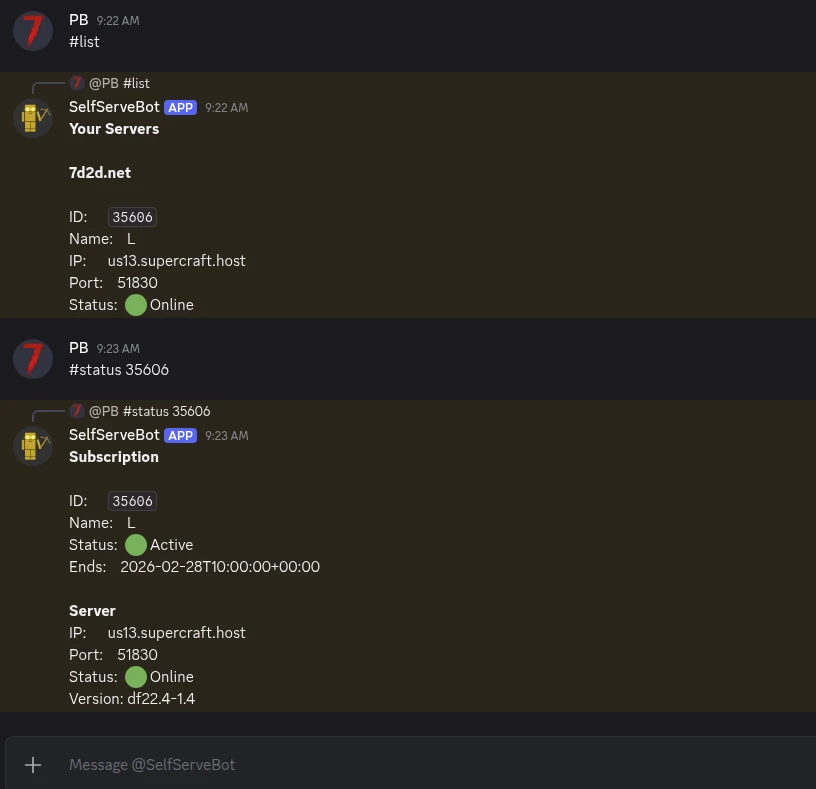
Self-Serve Bot in Discord

Instant control of your Rust server without tickets or waiting. Type a command and go.

  • Start, stop, restart, and check status in seconds.
  • Secure by design: only your subscriptions are accessible.
  • Share access safely with time-limited auth codes.

Fast, secure, and always on.

Discord chat commands for Rust server management

Latest Rust Guides & News

FAQ

Yes. We support Oxide/uMod plugins. Upload mods via the control panel or FTP and restart to apply changes.

Plans scale by player slots. Our Rust plans can support up to 100 players depending on the plan.

Yes. Upload your Rust world and server files via the file manager or FTP.

We host in US West (Oregon), US East (Virginia), US North-East (Toronto), Europe West (Paris), and Australia (Sydney).

Yes. We run automatic snapshots and provide on-demand backups for quick restores.

Average Rust server hosting cost is around $11-$15 per month for small groups and $20-$35 for larger communities. Dedicated server cost is driven by CPU for big maps and raid-heavy wipes, RAM for entity counts and plugins, storage I/O for wipes and backups, plus bandwidth, DDoS protection, and admin tooling.

Yes. In My Account → Subscriptions, you can upgrade to a higher tier of the same game with the same billing cadence (for example, monthly to monthly). Downgrades are not available right now. During an upgrade, your deployment is updated in place (quota update + restart), not wiped and recreated.

Rust Bunker Meta 2026: Raid-Cost Math That Actually Survives Wipe Week

Rust Bunker Meta 2026: Raid-Cost Math That Actually Survives Wipe Week

Most wipe-week losses are not unlucky raids. They are predictable math failures dressed as bad luck. That sentence keeps showing up in admin channels for a reason. Players are no longer judging servers by launch promises. They judge by whether the world stays stable, moderation stays coherent, and rules remain understandable under pressure. If you run Rust communities right now, this is where rust server hosting stops being a generic keyword and turns into day-to-day operational reality.

The hard truth is simple: when sentiment turns volatile, infrastructure quality and policy quality become inseparable. Strong hardware with chaotic rules still loses players. Clean rules with weak uptime still loses players. The winners are operators who treat server hosting as a product: versioned settings, documented intent, scheduled communication, and visible rollback discipline. This article focuses on that operator layer because it is where retention is won or lost.

What Is Driving This Topic in 2026

The current pressure point is active debates over honeycomb inflation, upkeep pressure, and realistic boom-cost assumptions in current Rust seasons. Players have better comparison habits than ever. They evaluate restart behavior, event consistency, moderation tone, wipe policy, and trust signals across multiple communities before committing. That means your server identity must be explicit. A vague “we do everything” posture usually collapses into reactive management and burnout.

For admins, this creates a practical challenge: you need enough flexibility to respond to real problems without making your environment feel random. A disciplined operating rhythm solves most of this tension. Set planned change windows, communicate scope, deploy one meaningful adjustment batch, and then measure before changing again. It sounds basic, but it beats impulsive daily tweaking by a wide margin.

Rust dedicated server hosting gameplay

Why It Becomes a Retention Problem Fast

Server-hosted communities last longer when base doctrine aligns with wipe tempo and admin policy. Most communities do not collapse in one dramatic incident. They degrade in layers: first the casuals disappear, then event organizers stop showing up, then long-session regulars drift toward better-run alternatives. By the time population drops are obvious, social momentum is already damaged.

The remedy is not louder marketing. It is operational credibility. Players need to see that your team can make decisions calmly, explain tradeoffs, and protect world continuity during bad weeks. If they trust your process, they tolerate difficult settings and occasional technical incidents. If they do not trust your process, even small hiccups trigger rumor cycles and churn.

7-Day Server Stabilization Plan

  1. Audit core settings and write one-sentence intent for each high-impact value.
  2. Publish a weekly operations note: what changes this week and what stays fixed.
  3. Lock restart windows and alert timings so players can plan around them.
  4. Verify backups by performing at least one real restore test.
  5. Track two daily KPIs: one stability metric and one engagement metric.

High-Impact Actions

  • Publish expected raid-cost benchmarks for your server style and population density.
  • Set wipe messaging early so clans plan around known risk windows.
  • Track offline-raid concentration and rebalance event cadence to spread pressure.
  • Use admin transparency logs for suspicious raid anomalies.
  • Separate high-risk PvP realms from community-building realms when possible.

Mistakes That Keep Repeating

  • Copying influencer bunker blueprints without evaluating local server economics.
  • Unannounced wipe policy changes that erase strategic planning.
  • Ignoring upkeep fatigue until large clans quit quietly.
  • Treating every raid complaint as cheating evidence without data.
Rust servers and hosting operations

Policy and Communication Rules That Work

Timestamp every relevant decision. If a change is experimental, label it experimental. If a rollback happens, explain root cause and next steps in one concise note. Ambiguity creates more damage than most technical incidents. Communities can live with imperfect execution; they struggle with leadership that looks inconsistent.

Second, keep staff alignment tight. Inconsistent moderator messaging is a known trust killer. Third, separate feedback intake from immediate policy changes. Listening does not mean changing settings in real time. Collect evidence for a defined window, then decide with intent. This keeps your server governable and prevents emotional policy swings.

30-Day Operations Blueprint

Days 1-7: freeze risky experiments and stabilize uptime, backups, and staffing coverage. Days 8-14: collect structured feedback and classify into performance, fairness, progression, and moderation. Days 15-21: deploy one controlled change wave with public notes. Days 22-30: evaluate impact, rollback weak changes, and lock next month priorities.

This cycle is deliberately boring, and boring is exactly what high-retention communities need. Predictability lets players invest socially. It also gives admins room to improve without panic mode. If your team can execute this rhythm for one full month, sentiment usually shifts from doomposting to constructive participation.

When Things Break: Incident Loop

  1. Declare incident scope quickly and provide next update timestamp.
  2. Freeze unrelated changes until core issue is understood.
  3. Collect evidence: logs, metrics, timeline, and player-facing symptoms.
  4. Apply smallest safe fix and watch for regressions.
  5. Publish post-incident summary with prevention actions.

That loop protects trust even when a technical event is ugly. Combined with stable dedicated hosting, it turns fragile communities into resilient ones. The key is consistency: same process, every time, regardless of who is on duty.

One practical habit makes this sustainable: keep a lightweight operations journal. Note what changed, why, what was observed, and what you will revisit next week. This creates continuity across shifts, reduces repeated mistakes, and gives your team a defensible record when community debates get noisy.

Reference Links

Need cleaner uptime and less admin firefighting? Launch your Rust server on dedicated hosting and run your community with predictable operations.

Quick FAQ

Q: Is this mostly a hardware issue?
A: Hardware matters, but policy coherence and release discipline usually decide long-term retention.

Q: How often should settings change?
A: In defined windows with clear notes. Constant unscheduled tweaks erode trust.

Q: Do players really care about changelogs?
A: Yes. Transparency converts confusion into patience.

Q: What baseline should every serious server have?
A: Dedicated hosting, tested backups, incident playbook, and stable communication cadence.

Q: What is the first win to chase?
A: Consistency over novelty. Predictable operations beat chaotic feature churn.

Rust Monument Route Economics: Scrap Paths for Solo, Duo, and Small Groups

Rust Monument Route Economics: Scrap Paths for Solo, Duo, and Small Groups

The scrap race is won by route discipline, not twitch aim highlights. That sentence keeps showing up in admin channels for a reason. Players are no longer judging servers by launch promises. They judge by whether the world stays stable, moderation stays coherent, and rules remain understandable under pressure. If you run Rust communities right now, this is where rust dedicated server hosting stops being a generic keyword and turns into day-to-day operational reality.

The hard truth is simple: when sentiment turns volatile, infrastructure quality and policy quality become inseparable. Strong hardware with chaotic rules still loses players. Clean rules with weak uptime still loses players. The winners are operators who treat server hosting as a product: versioned settings, documented intent, scheduled communication, and visible rollback discipline. This article focuses on that operator layer because it is where retention is won or lost.

What Is Driving This Topic in 2026

The current pressure point is increased community focus on recycler timing windows and route safety under mid-pop server conditions. Players have better comparison habits than ever. They evaluate restart behavior, event consistency, moderation tone, wipe policy, and trust signals across multiple communities before committing. That means your server identity must be explicit. A vague “we do everything” posture usually collapses into reactive management and burnout.

For admins, this creates a practical challenge: you need enough flexibility to respond to real problems without making your environment feel random. A disciplined operating rhythm solves most of this tension. Set planned change windows, communicate scope, deploy one meaningful adjustment batch, and then measure before changing again. It sounds basic, but it beats impulsive daily tweaking by a wide margin.

Rust dedicated server hosting gameplay

Why It Becomes a Retention Problem Fast

Dedicated hosting lets admins tune route risk so progression feels fair instead of random. Most communities do not collapse in one dramatic incident. They degrade in layers: first the casuals disappear, then event organizers stop showing up, then long-session regulars drift toward better-run alternatives. By the time population drops are obvious, social momentum is already damaged.

The remedy is not louder marketing. It is operational credibility. Players need to see that your team can make decisions calmly, explain tradeoffs, and protect world continuity during bad weeks. If they trust your process, they tolerate difficult settings and occasional technical incidents. If they do not trust your process, even small hiccups trigger rumor cycles and churn.

7-Day Server Stabilization Plan

  1. Audit core settings and write one-sentence intent for each high-impact value.
  2. Publish a weekly operations note: what changes this week and what stays fixed.
  3. Lock restart windows and alert timings so players can plan around them.
  4. Verify backups by performing at least one real restore test.
  5. Track two daily KPIs: one stability metric and one engagement metric.

High-Impact Actions

  • Map preferred solo and duo route loops and validate them against real encounter rates.
  • Keep recycler accessibility predictable to reduce frustration spikes.
  • Use event scheduling to avoid permanent choke-point camping culture.
  • Monitor peak-hour death clusters and adjust spawn pressure accordingly.
  • Brief moderators on route-dispute protocol to prevent inconsistent rulings.

Mistakes That Keep Repeating

  • Balancing monuments for zerg groups while ignoring solo retention collapse.
  • Frequent unannounced map tweaks that invalidate learned paths.
  • No telemetry on recycler area kill loops.
  • Conflating high lethality with healthy competitiveness.
Rust servers and hosting operations

Policy and Communication Rules That Work

Timestamp every relevant decision. If a change is experimental, label it experimental. If a rollback happens, explain root cause and next steps in one concise note. Ambiguity creates more damage than most technical incidents. Communities can live with imperfect execution; they struggle with leadership that looks inconsistent.

Second, keep staff alignment tight. Inconsistent moderator messaging is a known trust killer. Third, separate feedback intake from immediate policy changes. Listening does not mean changing settings in real time. Collect evidence for a defined window, then decide with intent. This keeps your server governable and prevents emotional policy swings.

30-Day Operations Blueprint

Days 1-7: freeze risky experiments and stabilize uptime, backups, and staffing coverage. Days 8-14: collect structured feedback and classify into performance, fairness, progression, and moderation. Days 15-21: deploy one controlled change wave with public notes. Days 22-30: evaluate impact, rollback weak changes, and lock next month priorities.

This cycle is deliberately boring, and boring is exactly what high-retention communities need. Predictability lets players invest socially. It also gives admins room to improve without panic mode. If your team can execute this rhythm for one full month, sentiment usually shifts from doomposting to constructive participation.

When Things Break: Incident Loop

  1. Declare incident scope quickly and provide next update timestamp.
  2. Freeze unrelated changes until core issue is understood.
  3. Collect evidence: logs, metrics, timeline, and player-facing symptoms.
  4. Apply smallest safe fix and watch for regressions.
  5. Publish post-incident summary with prevention actions.

That loop protects trust even when a technical event is ugly. Combined with stable dedicated hosting, it turns fragile communities into resilient ones. The key is consistency: same process, every time, regardless of who is on duty.

One practical habit makes this sustainable: keep a lightweight operations journal. Note what changed, why, what was observed, and what you will revisit next week. This creates continuity across shifts, reduces repeated mistakes, and gives your team a defensible record when community debates get noisy.

Reference Links

Need cleaner uptime and less admin firefighting? Launch your Rust server on dedicated hosting and run your community with predictable operations.

Quick FAQ

Q: Is this mostly a hardware issue?
A: Hardware matters, but policy coherence and release discipline usually decide long-term retention.

Q: How often should settings change?
A: In defined windows with clear notes. Constant unscheduled tweaks erode trust.

Q: Do players really care about changelogs?
A: Yes. Transparency converts confusion into patience.

Q: What baseline should every serious server have?
A: Dedicated hosting, tested backups, incident playbook, and stable communication cadence.

Q: What is the first win to chase?
A: Consistency over novelty. Predictable operations beat chaotic feature churn.

Rust Wipe Cadence Strategy: Weekly vs Biweekly Without Killing Population

Rust Wipe Cadence Strategy: Weekly vs Biweekly Without Killing Population

Wipe cadence is not a calendar preference. It is the strongest retention lever you control. That sentence keeps showing up in admin channels for a reason. Players are no longer judging servers by launch promises. They judge by whether the world stays stable, moderation stays coherent, and rules remain understandable under pressure. If you run Rust communities right now, this is where rust hosting wipe strategy stops being a generic keyword and turns into day-to-day operational reality.

The hard truth is simple: when sentiment turns volatile, infrastructure quality and policy quality become inseparable. Strong hardware with chaotic rules still loses players. Clean rules with weak uptime still loses players. The winners are operators who treat server hosting as a product: versioned settings, documented intent, scheduled communication, and visible rollback discipline. This article focuses on that operator layer because it is where retention is won or lost.

What Is Driving This Topic in 2026

The current pressure point is server operators split between high-frequency wipes for momentum and longer cycles for deeper social arcs. Players have better comparison habits than ever. They evaluate restart behavior, event consistency, moderation tone, wipe policy, and trust signals across multiple communities before committing. That means your server identity must be explicit. A vague “we do everything” posture usually collapses into reactive management and burnout.

For admins, this creates a practical challenge: you need enough flexibility to respond to real problems without making your environment feel random. A disciplined operating rhythm solves most of this tension. Set planned change windows, communicate scope, deploy one meaningful adjustment batch, and then measure before changing again. It sounds basic, but it beats impulsive daily tweaking by a wide margin.

Rust dedicated server hosting gameplay

Why It Becomes a Retention Problem Fast

Healthy rust hosting depends on matching wipe tempo to community identity and ops discipline. Most communities do not collapse in one dramatic incident. They degrade in layers: first the casuals disappear, then event organizers stop showing up, then long-session regulars drift toward better-run alternatives. By the time population drops are obvious, social momentum is already damaged.

The remedy is not louder marketing. It is operational credibility. Players need to see that your team can make decisions calmly, explain tradeoffs, and protect world continuity during bad weeks. If they trust your process, they tolerate difficult settings and occasional technical incidents. If they do not trust your process, even small hiccups trigger rumor cycles and churn.

7-Day Server Stabilization Plan

  1. Audit core settings and write one-sentence intent for each high-impact value.
  2. Publish a weekly operations note: what changes this week and what stays fixed.
  3. Lock restart windows and alert timings so players can plan around them.
  4. Verify backups by performing at least one real restore test.
  5. Track two daily KPIs: one stability metric and one engagement metric.

High-Impact Actions

  • Define your wipe identity publicly and keep it stable for at least one full month.
  • Test weekly and biweekly formats in separate seasons before finalizing.
  • Track retention by segment: solo, duo, clan, and event-driven players.
  • Align plugin strategy with cadence to avoid economy whiplash.
  • Publish post-wipe metrics to show evidence behind policy decisions.

Mistakes That Keep Repeating

  • Changing cadence reactively after one noisy Discord week.
  • Using identical rulesets across radically different wipe lengths.
  • No pre-wipe communication window for committed groups.
  • Ignoring moderation workload when scaling event density.
Rust servers and hosting operations

Policy and Communication Rules That Work

Timestamp every relevant decision. If a change is experimental, label it experimental. If a rollback happens, explain root cause and next steps in one concise note. Ambiguity creates more damage than most technical incidents. Communities can live with imperfect execution; they struggle with leadership that looks inconsistent.

Second, keep staff alignment tight. Inconsistent moderator messaging is a known trust killer. Third, separate feedback intake from immediate policy changes. Listening does not mean changing settings in real time. Collect evidence for a defined window, then decide with intent. This keeps your server governable and prevents emotional policy swings.

30-Day Operations Blueprint

Days 1-7: freeze risky experiments and stabilize uptime, backups, and staffing coverage. Days 8-14: collect structured feedback and classify into performance, fairness, progression, and moderation. Days 15-21: deploy one controlled change wave with public notes. Days 22-30: evaluate impact, rollback weak changes, and lock next month priorities.

This cycle is deliberately boring, and boring is exactly what high-retention communities need. Predictability lets players invest socially. It also gives admins room to improve without panic mode. If your team can execute this rhythm for one full month, sentiment usually shifts from doomposting to constructive participation.

When Things Break: Incident Loop

  1. Declare incident scope quickly and provide next update timestamp.
  2. Freeze unrelated changes until core issue is understood.
  3. Collect evidence: logs, metrics, timeline, and player-facing symptoms.
  4. Apply smallest safe fix and watch for regressions.
  5. Publish post-incident summary with prevention actions.

That loop protects trust even when a technical event is ugly. Combined with stable dedicated hosting, it turns fragile communities into resilient ones. The key is consistency: same process, every time, regardless of who is on duty.

One practical habit makes this sustainable: keep a lightweight operations journal. Note what changed, why, what was observed, and what you will revisit next week. This creates continuity across shifts, reduces repeated mistakes, and gives your team a defensible record when community debates get noisy.

Reference Links

Need cleaner uptime and less admin firefighting? Launch your Rust server on dedicated hosting and run your community with predictable operations.

Quick FAQ

Q: Is this mostly a hardware issue?
A: Hardware matters, but policy coherence and release discipline usually decide long-term retention.

Q: How often should settings change?
A: In defined windows with clear notes. Constant unscheduled tweaks erode trust.

Q: Do players really care about changelogs?
A: Yes. Transparency converts confusion into patience.

Q: What baseline should every serious server have?
A: Dedicated hosting, tested backups, incident playbook, and stable communication cadence.

Q: What is the first win to chase?
A: Consistency over novelty. Predictable operations beat chaotic feature churn.

Sally Field’s Black Hole Experience: Fact or Fiction?


Lost in the Abyss


Imagine being trapped in a black hole, with no escape, no way out. It’s a terrifying thought that has haunted scientists and philosophers for centuries. But what if I told you that there are people who have actually experienced this horror? Not just any people, but someone like Sally Field, an award-winning actress known for her iconic roles in movies like “Norma Rae” and “Steel Magnolias”. Yes, you read that right – Sally Field, the same person who won two Oscars and countless hearts with her performances.

But let’s get back to this bizarre situation. The story goes that Sally was once trapped in a black hole, or so she claims. Now, you might be thinking that this is just another wild celebrity rumor, but bear with me here, folks. This isn’t some far-fetched sci-fi tale; I’m talking about an actual event that allegedly occurred.

From what I’ve gathered, Sally found herself stuck in a black hole after attempting to communicate with an ancient alien civilization on the other side of the universe. Yeah, you read that right – aliens! Apparently, she was approached by this extraterrestrial entity, which led her down a rabbit hole (no pun intended) and into the depths of space-time.

Now, I know what you’re thinking: “Sally Field? Really? That’s a pretty wild claim.” And trust me, it is. But let’s not dismiss it just yet. Think about all the unexplained phenomena we’ve witnessed in this universe – from UFO sightings to mysterious energy readings that defy our understanding of physics. Who are we to say what’s possible and what’s not?

As I dug deeper into Sally’s story, I stumbled upon some eerie similarities between her experience and the theories of certain physicists. You see, they’re suggesting that black holes might not be just voids in space-time but actual gateways or portals to other dimensions. Yeah, mind blown, right? It’s as if our reality is about to get turned upside down.

Imagine, for a moment, being pulled into one of these cosmic wormholes and finding yourself in a realm beyond anything we can comprehend. I mean, the implications are staggering – think of all the secrets that could be hidden within those event horizons! It’s like something out of a sci-fi novel or a fantasy world, but here’s the thing: Sally Field claims she saw it with her own eyes.

Now, some might argue that this is just a publicity stunt gone wrong, while others might see it as a genuine attempt to share a life-changing experience. Me? I’m agnostic about the whole affair. What matters is that it raises more questions than answers.

As I wrapped up my research on Sally’s claims, I couldn’t help but think about our role in this grand tapestry we call reality. Are there mysteries waiting to be unraveled, or are we just stuck in some predetermined script? The universe is full of secrets, and sometimes the most unlikely sources can lead us down a rabbit hole (okay, I’ll stop with the puns now).

AlexTr1


Metadata:

* Focus keyphrase: Sally Field black hole experience
* SEO title: “Sally Field’s Black Hole Experience: Fact or Fiction?”
* Meta description: “Join me as we delve into the unexplained claims of award-winning actress Sally Field, who allegedly experienced being trapped in a black hole. Is this just a publicity stunt or something more profound? Let’s explore the implications and unravel the mystery.”

Satisfactory 1.1 Experimental Hosting: Fast Updates, Broken Expectations, Admin Playbook


Satisfactory 1.1 Experimental Hosting: Fast Updates, Broken Expectations, Admin Playbook

Experimental branches are fun until your save pipeline breaks at 2 a.m. and everyone pings admin at once. In the current cycle around February 2026, the conversation around Satisfactory is not only about features. It is about governance, expectations, and whether your community can trust your dedicated servers to stay consistent under pressure. If you run community infrastructure, this is exactly where satisfactory dedicated server hosting becomes practical, not marketing fluff. Players do not care how elegant your panel looks if the world stutters, resets unexpectedly, or rules change without warning. They care about fairness, uptime, and clear admin intent. This guide is built from that reality: messy, opinionated, and field-tested.

Across forums, Discord channels, and community reports, one pattern keeps repeating: admins copy “recommended” defaults, then wonder why retention collapses after the initial spike. The problem is not effort. The problem is policy drift. You launch one vision, then slowly mutate into another under pressure from loud player segments. No blame here, this happens to almost everyone. But if you want strong retention, your configuration, moderation style, and content cadence have to align from day one. That is why this article focuses on operations, not theory, and why we keep repeating the fundamentals: stable hosting, dedicated resources, clear rules, and predictable server behavior.

Why This Topic Is Hot Right Now

The current debate is driven by the tension between early feature access and production-grade stability. In practical terms, communities are asking one hard question: should admins follow official defaults, or optimize for the way real groups actually play? The official route gives legitimacy and easier documentation. The community route gives better retention when tuned well. Neither side is fully wrong. But pretending they are equivalent is where admins lose momentum. For dedicated hosting, this means your server plan is not just hardware sizing. It is a product decision with social consequences. Tick rate, restart windows, backup cadence, and moderation response times influence culture as much as patch notes do.

Another reason this topic is hot is transparency. Players compare servers constantly now. They cross-check uptime claims, ask for changelogs, and share screenshots of admin decisions. A single inconsistent reset can trigger migration. A single hidden tweak can trigger conspiracy threads. That sounds dramatic, but experienced operators already know this pattern. The fix is straightforward: publish your rules, publish your maintenance windows, and publish what changed after every significant update. When people know what to expect, they tolerate imperfections. When everything feels random, even good updates look suspicious.

Community vs Official: What Actually Breaks in Practice

Satisfactory dedicated server hosting screenshot

Let us strip out ideology and talk failure modes. Official settings often underperform for mid-size communities because they assume generic behavior. Community settings often underperform because they are over-tuned for one loud subgroup. In both cases, admins discover the same pain points: progression pacing mismatch, economy imbalance, PvP/PvE friction, and unclear enforcement. These are not technical bugs. They are design bugs in server policy. If you want your dedicated servers to feel premium, treat configuration like versioned code. Track changes. Roll them out intentionally. Measure results over at least one full weekly cycle before declaring victory.

A practical rule: optimize for the median committed player, not for the loudest edge case. That means balancing convenience with effort, and excitement with sustainability. For example, ultra-fast progression can spike short-term concurrency but often destroys long-term goals. Hyper-punitive systems can look hardcore but kill casual social groups that keep communities alive between major updates. Reliable hosting helps, but it cannot save a design that burns trust. Your server should feel coherent, not chaotic. When users can explain your rules in one sentence, you are usually on the right track.

Admin Playbook: 30-Day Dedicated Server Strategy

Week 1: Stabilize first. Lock critical settings, run predictable restarts, and monitor performance at peak hours. Do not run experimental rule changes during launch traffic. Week 2: Gather evidence. Use logs, player feedback channels, and admin notes to identify two or three high-impact friction points. Week 3: Run controlled changes. Adjust one cluster of settings at a time, announce it clearly, and observe behavior for several days. Week 4: Consolidate. Keep what worked, rollback what failed, and publish a concise changelog so players see the logic behind your decisions.

This 30-day pattern sounds simple, yet it outperforms impulsive daily tweaks. It also aligns perfectly with professional hosting operations: scheduled backups, predictable resource usage, and clear incident response. If you are serious about satisfactory dedicated server hosting, your goal is not to look busy. Your goal is to produce a server environment where players can invest confidently. That confidence is what converts casual visitors into regulars, and regulars into moderators who help you scale. In short: sustainable communities are built by consistency, not heroics.

Configuration Principles That Age Well

Satisfactory servers and hosting gameplay

First principle: document intent, not just values. Writing “loot multiplier = X” is less useful than writing “we keep scarcity moderate to protect trade and exploration value.” Second principle: pre-commit rollback thresholds. If a change increases crash frequency, queue delay, or abandonment indicators beyond your threshold, revert quickly. Third principle: keep moderation policy and technical policy aligned. If your rules encourage risk-taking but punish every failure harshly, players perceive hypocrisy. That perception harms retention faster than most performance issues. Reliable dedicated hosting gives you room to iterate safely, but policy coherence is still your core lever.

Fourth principle: announce changes before they happen, not after. Treat your players like collaborators, not passive consumers. Fifth principle: isolate contentious features in events or temporary realms before promoting them to the main environment. Sixth principle: train your admin team on message discipline. Conflicting admin statements create more damage than a short outage. None of this is glamorous, but it is what separates servers that survive seasonal spikes from servers that die after one viral weekend. If this sounds strict, good. Mature communities want adults in the room.

Useful Links and Next Actions

If you are rebuilding your stack now, prioritize boring excellence: stable backups, clear restart policy, transparent changelogs, and hardware that can absorb peak load without panic mode. That formula wins repeatedly across games, communities, and patch cycles. No magic. Just disciplined operations and honest communication.

Want a faster path with fewer admin headaches? Launch a managed setup built for uptime, backups, and clean scaling: start your Satisfactory server hosting stack.

Quick FAQ for Busy Admins

Q: Should I copy official defaults exactly?
A: Start there, but do not stop there. Defaults are a baseline. Community behavior should guide your final server profile.

Q: How often should I change settings?
A: In batches, usually weekly. Daily unplanned changes erode trust unless you are handling incidents.

Q: What is the most ignored retention lever?
A: Communication clarity. Players tolerate strict rules if they are consistent and visible.

Q: What matters more, hardware or policy?
A: You need both. Weak hardware kills performance, but weak policy kills community identity.

Q: What is the minimum professional baseline?
A: Dedicated resources, automated backups, incident playbook, and a public changelog rhythm.

Satisfactory 1.1 Power Surge | Cheap Satisfactory Server Hosting Tips

Satisfactory 1.1 Power Surge | Cheap Satisfactory Server Hosting Tips

Update 1.1 brings bigger factories, the Power Surge rework, and new blueprint toys—great news for engineers, but brutal for underpowered servers. Here is how we keep Satisfactory server hosting stable when the patch lands.

What the Power Surge patch changes

  • Power consumption spikes during reactor warmups jump by up to 30%.
  • Blueprint streaming pushes more data when multiple engineers paste builds simultaneously.
  • Fluid dynamics updates hit CPU-bound servers harder when refineries run at 100% clock speed.

If you are running cheap Satisfactory server hosting on shared hardware, those spikes become lag. Our approach is to over-provision before the update, then trim once metrics settle.

Dedicated server checklist

  1. Snapshot everything. Use the built-in backup tool plus an off-site copy (we ship both) before patching.
  2. Stage the update. Spin up a second world, apply Update 1.1, and benchmark train throughput before promoting it.
  3. Blueprint audit. Run the blueprint upload workflow so everyone is on the same revision.
  4. Power budget. Leave 20% headroom or configure our auto-scaling policy to add vCPU during surge windows.
  5. Alerting. Pipe Grafana webhooks into Discord so you know when consumption exceeds thresholds.

Recommended resources per engineer count

Concurrent engineersvCPURAMNotes
1-44 dedicated8 GBGreat for blueprint testing worlds.
5-106 dedicated12 GBAdd NVMe scratch space for faster autosaves.
10-168 dedicated16 GBEnable autosave staggering and packet prioritization.
16+10+ dedicated24 GBUse region-paired servers and split factories per biome.

Why Supercraft for affordable Satisfactory hosting?

We deploy Ryzen 9 nodes with NVMe, give you instant Update 8 ↔ 1.1 toggles, and stream metrics to Discord. That keeps your cheap Satisfactory server hosting plan fast without hidden slot fees.

Need help migrating or tuning? Ping us on Discord or book a free review; we will move your saves, optimize power shards, and keep your Satisfactory servers stable for the next content drop.

Satisfactory 1.2 Update: Everything We Know About the Upcoming Fluid Transport Revolution


Satisfactory 1.2 Update: Everything We Know About the Upcoming Fluid Transport Revolution

Satisfactory 1.2 Update: Everything We Know About the Upcoming Fluid Transport Revolution

The satisfactory 1.2 update is the next major release coming to Coffee Stain Studios’ factory-building phenomenon, scheduled for the first half of 2026. Following the game’s successful 1.0 launch and console release in late 2025, satisfactory 1.2 promises to revolutionize fluid logistics with new transport options and deliver massive performance improvements that could cut memory usage in half.

Satisfactory 1.2 update preview showing fluid transport improvements and factory optimization

TL;DR:

  • The satisfactory 1.2 update launches in first half of 2026 with Experimental testing likely starting in April 2026
  • New fluid transport system introduces tanker trucks and Fluid Truck Stations for liquid logistics
  • Performance optimizations could reduce memory usage by up to 50% in mega-factories
  • Shallow water extraction allows oil and water extractors to work in shallow water areas
  • Potential Unreal Engine 5.4 upgrade rumored for enhanced graphics and performance
  • Game mode variations and resource node randomization hinted by developers

Table of Contents

  1. What’s New in Satisfactory 1.2
  2. Release Timeline and Testing Roadmap
  3. Deep Dive: Major Features
  4. What It Means for Players and Server Owners
  5. FAQ
  6. Conclusion

What’s New in Satisfactory 1.2

The satisfactory 1.2 update represents the first major post-launch content addition, focusing on solving one of the game’s most requested features: better fluid transportation options. After the massive success of the 1.0 release and console launch, Coffee Stain Studios is addressing community feedback with targeted improvements in satisfactory 1.2.

Major Highlights

Fluid Transport Revolution:

  • New tanker trucks designed specifically for transporting liquids across long distances
  • Fluid Truck Stations with pipeline inputs and outputs for automated fluid loading and unloading
  • Solving the long-standing challenge of moving oil, fuel, and water without extensive pipe networks
  • Integration with existing vehicle automation systems for hands-free operation
Satisfactory 1.2 fluid truck station and tanker vehicle preview

Massive Performance Improvements:

  • Up to 50% memory reduction through hitbox optimization on distant objects
  • Temporary hitbox disabling for far-away belts, pipes, and hypertubes
  • Testing shows memory usage dropping from 60GB to 30GB in mega-factories
  • Smoother performance for players with large-scale production facilities

Extraction Enhancements:

  • Oil Extractors can now extract oil from shallow water areas
  • Water Extractors similarly work in shallow water zones
  • More flexible placement options for resource gathering buildings
  • Expands viable locations for early-game and late-game resource collection

Quality of Life Improvements:

  • Vehicle route system improvements for easier automation
  • Hints at new game mode variations for different playstyles
  • Resource node randomization option teased by developers
  • Additional QoL features expected based on community feedback

Release Timeline and Testing Roadmap

Confirmed Schedule

  • Q1-Q2 2026: The satisfactory 1.2 release window (first half of 2026)
  • April 2026 (Expected): Experimental branch testing begins
  • Testing Period: Several weeks to months of community testing on Experimental
  • Stable Release: Following successful Experimental testing phase

Testing Process

Based on Coffee Stain Studios’ established update patterns, satisfactory 1.2 will follow a structured testing approach:

  • Experimental Branch: First access for players who opt into testing builds
  • Community Feedback: Bug reports and balance suggestions from early testers
  • Iteration Phase: Developers refine features based on real-world usage data
  • Beta Branch: More stable testing before full release
  • Stable Release: Final rollout to all players

Rumored Content

  • Unreal Engine 5.4 upgrade for improved graphics and performance capabilities
  • Additional building customization options
  • Further automation enhancements beyond fluid transport
  • Potential new tier content (unconfirmed speculation)

Deep Dive: Major Features

Fluid Transport System: The Game-Changer

The introduction of fluid-carrying trucks represents the most significant logistical advancement in satisfactory 1.2, addressing one of the community’s most persistent requests since Early Access.

The Problem It Solves: Currently, transporting liquids requires building extensive pipe networks across the map. For distant oil fields or isolated water sources, this means laying hundreds of meters of pipes, dealing with vertical pumping limitations, and managing complex pipe routing. The new tanker trucks eliminate this infrastructure burden.

Satisfactory 1.2 fluid logistics system showing tanker trucks and automated stations

How It Works: Based on developer teasers and community analysis, the Fluid Truck Station functions similarly to existing truck stations but with pipeline connections. Players can route fluids into the station, where tanker trucks automatically load, drive to a destination station, and unload into the receiving pipeline network. This creates a “pipe-free” fluid transport option that uses the existing vehicle path system.

Practical Applications:

  • Connecting remote oil nodes without 1000m+ pipe runs
  • Transporting packaged fluids more efficiently than conveyor belts
  • Creating modular fuel distribution networks for vehicle fleets
  • Supplying water to distant factories without pump cascades
  • Enabling flexible factory layouts that aren’t constrained by pipe routing

Integration with Existing Systems: The tanker trucks will use the same automation and pathfinding systems as current vehicles, meaning players familiar with truck routing will adapt quickly. The Fluid Truck Stations accept standard pipeline connections, making integration with existing factories straightforward.

Performance Optimization: Technical Deep Dive

The satisfactory 1.2 performance improvements target one of the game’s most resource-intensive calculations: collision detection for factory components.

The Technical Solution: Coffee Stain Studios implemented dynamic hitbox management that temporarily disables collision boxes on objects beyond a certain distance from the player. Belts, pipes, and hypertubes—which collectively can number in the tens of thousands in mega-factories—no longer consume memory for collision calculations when far from the player’s view.

Real-World Impact: Internal testing revealed dramatic results, with one test case showing memory usage dropping from 60GB to 30GB in a massive factory. This 50% reduction means:

  • Fewer crashes and out-of-memory errors on systems with 16GB or 32GB RAM
  • Smoother performance when navigating large factory complexes
  • Ability to build even larger factories without hitting technical limits
  • Better multiplayer server stability with reduced memory overhead

No Gameplay Impact: The optimization is entirely transparent to players. Hitboxes re-enable automatically when approaching objects, ensuring normal interaction at close range. Players won’t notice any functional difference beyond better performance.

Shallow Water Extraction

The ability to place Oil Extractors and Water Extractors in shallow water areas provides meaningful flexibility for factory planning.

Strategic Benefits:

  • Access to coastal oil deposits without building over water
  • Easier early-game water access near ocean spawn points
  • More placement options reduce factory design constraints
  • Potential for offshore extraction facilities near resource nodes

This feature, while less flashy than tanker trucks, addresses practical pain points many players encounter during factory expansion phases.

Quality of Life and Game Modes

Coffee Stain Studios has hinted at additional features for satisfactory 1.2 without full details:

Vehicle Route Improvements: Expect refinements to the vehicle automation system, potentially including better waypoint management, more reliable pathfinding, and easier multi-stop route configuration.

Satisfactory 1.2 game modes and vehicle automation improvements preview

Game Mode Variations: Developers have teased new game modes but emphasized these won’t be post-game or end-game extensions. This likely means alternative starting conditions or modified rules rather than content beyond current tier progression.

Resource Node Randomization: This feature would randomize resource node placement and types, dramatically increasing replayability by forcing different factory layouts and strategies each playthrough.

What It Means for Players and Server Owners

For Solo Players

  • Easier Fluid Management: No more multi-kilometer pipe runs to distant oil fields
  • Better Performance: Existing mega-factories will run smoother on the same hardware
  • More Design Freedom: Factory layouts no longer constrained by fluid logistics limitations
  • Replayability: Resource randomization offers fresh challenges for veteran players
  • Experimental Access: Join testing in April 2026 to try new features early and provide feedback

For Multiplayer Groups

  • Collaborative Logistics: Truck-based fluid networks easier to coordinate than complex pipe systems
  • Reduced Lag: Memory optimizations improve performance for all players on shared servers
  • Flexible Expansion: Team members can build satellite factories connected by tanker trucks
  • Varied Experiences: New game modes create opportunities for different multiplayer challenges

For Dedicated Server Administrators

  • Memory Savings: 50% reduction in peak memory usage allows hosting on more affordable hardware
  • Improved Stability: Lower memory pressure reduces server crashes and restarts
  • Larger Capacity: Support more concurrent players or larger factories on existing infrastructure
  • Easy Updates: satisfactory 1.2 servers will update through standard processes
  • Planning Needed: Prepare for Experimental testing period with potential save compatibility considerations

For server hosting providers and administrators running satisfactory 1.2 dedicated servers, the performance improvements represent a significant cost-saving opportunity while simultaneously improving player experience.

FAQ

When does satisfactory 1.2 release?

The satisfactory 1.2 update is scheduled for the first half of 2026, with Experimental branch testing expected to begin around April 2026. The stable release will follow after community testing and refinement.

Will my existing save work with satisfactory 1.2?

Coffee Stain Studios typically maintains save compatibility across updates. However, Experimental versions may have compatibility issues. Wait for stable release or back up saves before testing Experimental builds.

Is satisfactory 1.2 a free update?

Yes, all major Satisfactory updates including satisfactory 1.2 are free for all owners of the game. No additional purchase is required to access the fluid transport system, performance improvements, or any other features.

How do I access the Experimental branch?

When testing begins, right-click Satisfactory in your Steam library, select Properties > Betas, and choose “experimental” from the dropdown menu. Note that Experimental builds may be unstable and could corrupt saves.

Will fluid trucks replace pipes entirely?

No, pipes will remain essential for factory-internal fluid distribution. Tanker trucks solve the long-distance transport challenge but aren’t designed to replace the pipe network within your production facilities.

What’s the capacity of fluid trucks?

Specific capacity numbers haven’t been officially announced. This information will likely emerge during Experimental testing as players experiment with the new system.

Does the memory optimization affect gameplay?

The optimization is entirely behind-the-scenes. Players won’t notice any functional changes beyond better performance and reduced memory usage. All factory components work exactly as before.

Can I run satisfactory 1.2 on Experimental and Stable simultaneously?

No, but you can switch between branches. Create separate save files for Experimental testing to avoid potential corruption of your main Stable save.

Will there be new tiers in satisfactory 1.2?

No new tiers have been announced for satisfactory 1.2. The update focuses on logistics improvements and performance rather than extending the tech tree beyond current tier 8.

What about the Unreal Engine 5.4 upgrade?

An Unreal Engine upgrade is rumored but not officially confirmed. If implemented, it could bring improved graphics capabilities and additional performance benefits beyond the announced optimizations.

Conclusion

The satisfactory 1.2 update represents Coffee Stain Studios’ commitment to evolving the game beyond its successful 1.0 launch. By focusing on the community’s most requested feature—better fluid logistics—and coupling it with game-changing performance improvements, satisfactory 1.2 addresses both wishlist items and technical limitations.

The fluid transport system promises to fundamentally change how players approach factory design. No longer constrained by the complexity and resource cost of long-distance pipe networks, engineers can design more flexible, distributed production facilities. Remote oil fields become viable without massive infrastructure investment, and modular factory designs become practical at scales previously limited by fluid logistics.

The performance optimizations might be even more significant for the game’s long-term health. Cutting memory usage in half doesn’t just help players with existing mega-factories—it dramatically raises the ceiling for how large and complex Satisfactory factories can become. This future-proofs the game for years of continued expansion and experimentation.

For the dedicated server community, satisfactory 1.2 delivers meaningful operational improvements. Lower memory requirements reduce hosting costs while supporting larger, more ambitious multiplayer projects. Server administrators can confidently plan for growing communities and expanding factories without worrying about hitting hardware limits.

As we approach the Experimental testing phase in April 2026, the Satisfactory community has much to look forward to. Whether you’re a solo builder planning your next mega-factory, a multiplayer team coordinating production networks, or a server administrator managing infrastructure, satisfactory 1.2 brings substantial improvements to every aspect of the game.

The wait until first-half 2026 won’t be easy for eager engineers, but Coffee Stain Studios has built trust through years of consistent, quality updates. Based on their track record documented on the official Satisfactory wiki, we can expect a well-tested, polished release that lives up to the community’s high expectations.

Prepare your factories, plan your fluid networks, and get ready for the most significant logistical revolution since the introduction of trains. The satisfactory 1.2 update is coming, and it’s bringing the tools to build bigger, faster, and more efficiently than ever before.

Satisfactory Anniversary Event: Update 1.2, Console Launch, and 2026 Roadmap

Satisfactory Anniversary Event: Update 1.2, Console Launch, and 2026 Roadmap

The Satisfactory anniversary event lands on September 10, and it kicks off a packed stretch that includes Update 1.2, the console launch, Ficsmas, and new behind-the-scenes content in 2026. Here is what is confirmed, what is heavily teased, and what long-time pioneers can realistically expect.

  • Anniversary event on September 10 with new cosmetics and at least two fresh helmets.
  • Update 1.2 reveal in October, likely landing with the November 4 console launch.
  • Ficsmas returns December 1 with gifts, seasonal crafting, and familiar decorations.
Satisfactory anniversary event update 1.2 roadmap
Key beats for Satisfactory through 2026: anniversary event, Update 1.2, console launch, and ongoing updates.

Satisfactory anniversary event: what is confirmed so far

The September 10 anniversary marks one year since version 1.0 left Early Access. Coffee Stain has confirmed the event is happening and has already teased two new helmets—a cup holder helmet and a doggo helmet. A recent dev video also lined up the chainsaw with weapons, hinting that the tool may get new functionality.

  • Cosmetics: At least two helmets are coming, with more party-themed items possible.
  • Chainsaw spotlight: Seeing it beside weapons suggests a new combat or crowd-control mode.
  • Timing: The helmets could ship with the anniversary event or arrive shortly after.

Speculation grounded in teasers

Nothing below is confirmed, but every item ties back to screenshots, past events, or developer jokes from the last few weeks.

  • Chainsaw weapon mode: A toggle for tree cutting, area clearing, and melee damage would finally add variety beyond the Xeno Basher.
  • New mixtape: A background screenshot mentioned a mixtape, suggesting fresh radio tracks.
  • Bean balloon and neon hub: Visual teasers reference a bean balloon and neon lighting that could refresh the HUB or add celebratory map props.
  • Fauna party cosmetics: April 1 proved animals can get themed outfits; expect party hats on doggos, ribbons on hogs, and bright colors on spitters.
  • Hidden gifts: Imagine scanning caves, waterfalls, and cliff edges for wrapped gifts that grant reinforced plates, rotors, or rare late-game parts.

Update 1.2 reveal and likely launch window

The studio says Update 1.2 details will arrive in October. Given that the console launch is set for early November, the safest bet is that Update 1.2 drops the same week—possibly the exact day—consolidating patch testing across PC, Xbox, and PlayStation.

  • Performance and polish: The team is framing 1.2 as a significant update, not a small hotfix.
  • Cross-platform alignment: Shipping near the console launch would keep PC and console content in sync.
  • Watchlist: Full patch notes, any new buildings, and whether fluid logistics expand further.

Console release on November 4

Satisfactory finally arrives on Xbox Series X|S and PlayStation 5 on November 4, with crossplay between the two console families. Old-gen consoles are not supported, but new players could arrive by the tens of thousands, reshaping community blueprints and factory designs. For an official overview, see the Satisfactory site.

  • Modes: Performance (60 FPS), Quality (30 FPS), and a PS5 Pro enhancement option.
  • Crossplay: Xbox and PlayStation will talk to each other; PC crossplay is still off the table at launch.
  • Server planning: Expect a surge of co-op factories as console players join established PC friends via dedicated servers.

Ficsmas returns December 1

The annual Ficsmas event runs into January, offering relaxed holiday progression. Expect falling gifts, seasonal research, craftable decorations, and familiar themed buildings. Even if you skipped prior years, this is the easiest way to grab limited-time items.

  • Seasonal gifts dropping from the sky.
  • Unique craftables and ornaments for late-game factory decor.
  • Plenty of time to complete the event before it expires.

Behind-the-scenes content and 2026 outlook

Developer Miquel teased a “smidge” of behind-the-scenes content, potentially a studio tour or documentary on how Satisfactory is made. Expect this closer to 2026, alongside ongoing updates that could introduce new biomes, creatures, or structures once the console audience is settled.

Roadmap at a glance

  • September 10: Satisfactory anniversary event with cosmetics and possible chainsaw changes.
  • October: Update 1.2 deep dive.
  • November 4: Console launch, likely paired with Update 1.2 rollout.
  • December: Ficsmas seasonal event returns.
  • 2026: Behind-the-scenes content and further QoL updates.

Want day-one stability for the anniversary event and Update 1.2? Spin up a dedicated world with our Satisfactory server hosting guide to keep your factory online for every milestone.

Satisfactory Beginner’s Guide: 15 Essential Tips to Build the Perfect Factory


Satisfactory Beginner’s Guide: 15 Essential Tips to Build the Perfect Factory

Satisfactory doesn’t punish mistakes—it rewards inefficiency with bottlenecks, spaghetti conveyors, and power grids that collapse at the worst possible moment. If you’re staring at your first resource node wondering whether to automate or hand-craft, you’re about to make decisions that will haunt you for 50 hours. This guide cuts through the overwhelm with 15 battle-tested tips that separate clean, scalable factories from chaotic rebuilds. From hotbar management to power planning, we’re covering what experienced players wish they knew on day one.

TL;DR

  • Build everything on foundations using the world grid—future you will thank present you
  • Unlock Blade Runners, parachute, and rebar gun immediately—mobility saves hours
  • Multiple portable miners on one node = instant production boost (early game only)
  • Coal power unlocks at Tier 3—rush it to escape biomass burner hell
  • The AWESOME Sink turns waste into coupons—use it from day one
  • There’s no time limit and you can’t fail—experiment without fear

Table of Contents

Getting Started: Your First Hour

1. Choose Your Starting Location Wisely

You’ll spawn in one of four biomes. For beginners, the Grass Fields offers the best balance:

  • Grass Fields: Gentle terrain, nearby resources, minimal hostile creatures (recommended)
  • Rocky Desert: Flat building space but limited water access
  • Northern Forest: Beautiful but challenging terrain and aggressive wildlife
  • Dune Desert: Expert-tier start with extreme terrain challenges

Don’t stress too much—you can always relocate later. The game has no time pressure.

2. Hand-Craft Only What’s Necessary

Your first 30 minutes will involve manual crafting. Prioritize:

  1. Portable Miner (×3-4): Your first automation step
  2. Smelter (×2-3): Convert ore to ingots automatically
  3. Storage Container (×2): Prevent inventory overflow
  4. Biomass Burners (×4-6): Early power generation

Everything else should be automated as quickly as possible. Hand-crafting is the enemy of progress.

Satisfactory screenshot

3. The Portable Miner Stacking Trick

Here’s an early-game secret that drastically accelerates progression:

  • You can place multiple portable miners on a single resource node
  • Each miner extracts independently—double or triple your output instantly
  • This only works until you unlock Miner Mk.1 (which prohibits stacking)
  • Use this window to stockpile iron ore and copper ore aggressively

Pro Tip: Place 2-3 portable miners on your nearest pure iron node and let them run overnight. Wake up to thousands of ore.

Early Automation and Resource Management

4. Automate Smelting Before Anything Else

Your first real factory step:

  1. Place Miner Mk.1 on iron node
  2. Connect conveyor belt to smelters (at least 2)
  3. Smelters output to storage containers
  4. Storage connects to Constructor for basic parts

This simple chain eliminates 90% of early-game hand-crafting tedium.

5. Don’t Hoard Resources—Use the AWESOME Sink

The AWESOME Sink is unlocked early and is criminally underutilized:

  • Converts excess items into “FICSIT Coupons”
  • Coupons unlock useful items, statues, and cosmetics
  • Prevents storage overflow and production bottlenecks
  • Connect overflow from production lines directly to the Sink

If you’re producing more than you need, sink it. Storage space is valuable.

Satisfactory screenshot

6. Conveyor Belt Basics: Speed Matters

Conveyor belts have speed tiers:

  • Mk.1: 60 items/min (early game)
  • Mk.2: 120 items/min (unlocked Tier 2)
  • Mk.3: 270 items/min (mid-game)
  • Mk.4+: Late-game speeds

Match your belt speed to your production rate. A Miner Mk.1 at 100% purity produces 60/min—a Mk.1 belt is perfect. Upgrading belts too early wastes resources; upgrading too late creates bottlenecks.

For the latest belt tiers and miner outputs, check the Satisfactory Wiki.

7. One Task at a Time—Seriously

Satisfactory’s scope is overwhelming. Combat this by:

  • Finishing one production line completely before starting another
  • Completing one Milestone before tackling the next
  • Ignoring exploration urges until your base power is stable

Players who juggle multiple projects simultaneously end up with half-finished spaghetti messes.

Building and Organization Strategies

8. Always Build on Foundations Using the World Grid

This is the single most important tip in this entire guide:

  • Foundations snap to a global 8×8 meter grid
  • Machines placed on foundations align perfectly
  • Belts, pipes, and power lines become dramatically easier to organize
  • Expanding your factory becomes trivial instead of nightmarish

How to enable world grid alignment:

  1. Open settings → Gameplay
  2. Enable “Build Grid Snapping”
  3. Place your first foundation—all subsequent foundations will align to the world grid

Players who ignore this advice spend 20+ hours rebuilding their entire base later. Don’t be that player.

Satisfactory screenshot

9. Master the Hotbar System

Satisfactory’s hotbar is more powerful than it appears:

  • You have 10 hotbars (not just one)
  • Hold Alt + Scroll Wheel to switch between them
  • Organize by build phase: one hotbar for production, one for power, one for logistics
  • Assign frequently-used buildings to number keys

Example hotbar setup:

  • Hotbar 1: Foundations, walls, ramps
  • Hotbar 2: Miners, smelters, constructors
  • Hotbar 3: Belts, splitters, mergers
  • Hotbar 4: Power poles, biomass burners

10. Leave Space—Then Leave More Space

Every beginner builds too compactly. Follow these spacing rules:

  • Between production rows: Minimum 3 foundations width (for walkways and belts)
  • Factory floors: 4 meters vertical clearance (two wall segments high)
  • Around resource nodes: 10×10 foundation area reserved for future upgrades

You’ll expand every production line at least three times. Plan for it now.

Power Management and Coal Transition

11. Rush Coal Power at Tier 3—Biomass Is a Trap

Biomass burners are:

  • Manual (you must constantly refuel them)
  • Inefficient (low power output per fuel)
  • Time-consuming (gathering leaves/wood interrupts factory work)

Coal power, unlocked at Tier 3, is:

  • Automatic (self-sustaining with miners and water extractors)
  • Scalable (easily add more generators)
  • Reliable (no manual intervention needed)

Goal: Reach Tier 3 within your first 4-6 hours and immediately transition to coal. This unlocks the real game.

Satisfactory screenshot

12. Overestimate Power Needs by 30%

Power math:

  • Coal Generator = 75 MW
  • Early base consumption = 50-100 MW
  • Mid-game consumption = 300-500 MW

Always build 30% more power capacity than you currently need. Running at 95% capacity means your next machine addition causes a grid collapse.

13. Water Ratios for Coal Power

Optimal coal power setup:

  • 3 Water Extractors = 8 Coal Generators (perfect ratio)
  • One Coal Miner Mk.1 (at normal purity) = 8 Coal Generators
  • Result: 8 generators = 600 MW power

Build in sets of 8 for maximum efficiency and easy mental math.

Essential Research and Unlocks

14. Prioritize These MAM Research Trees

The MAM (Molecular Analysis Machine) unlocks critical quality-of-life items. Research in this order:

  1. Quartz → Blade Runners: 200% movement speed on foundations (game-changing)
  2. Mycelia → Fabric → Parachute: Survive falls, explore safely
  3. Caterium → Power Storage: Buffer your power grid against spikes
  4. Nutrients → Rebar Gun: Defend against hostile creatures

Most players regret not getting Blade Runners immediately. The movement speed boost is addictive and saves hundreds of hours of walking.

15. Hard Drive Hunting: Worth It or Not?

Crash sites contain Hard Drives that unlock alternate recipes. Priorities:

  • Early game: Skip them unless one is directly on your path
  • Mid-game: Collect systematically during exploration
  • Late-game: Essential for optimizing complex production chains

Don’t obsess over alternate recipes initially—solid fundamentals matter more than recipe optimization.

Common Mistakes to Avoid

Building Before Planning

Spend 5 minutes planning your production line layout before placing machines. Sketching on graph paper (or using the Satisfactory Calculator website) prevents costly rebuilds.

Ignoring Milestones

Milestones gate progression. Don’t get distracted by exploration or megabase dreams—focus on completing the next Milestone first.

Overcomplicating Early Designs

Your first factory doesn’t need to be perfect. Build functional first, optimize later. Tiers 1-3 are tutorials—you’ll rebuild everything anyway.

Not Labeling Production Lines

Use signs and rename storage containers. “Iron Ingots” is clearer than “Storage Container #7.” Future you (and your multiplayer teammates) will appreciate the labels.

Multiplayer and Server Considerations

For Server Owners

  • Specs: 4GB RAM minimum for 2-4 players; 8GB for 4-8 players; 16GB for larger groups
  • Autosave Frequency: Enable autosaves every 5-10 minutes—Satisfactory can crash
  • World Sync: First player to join creates the world; everyone else joins that world
  • Performance: Dedicated servers outperform player-hosted for 3+ players

For Multiplayer Players

  • Communication is key: Use Discord or in-game chat to coordinate building
  • Divide responsibilities: One player on power, one on production, one on exploration
  • Shared inventory: All players share Milestones and research—progress together
  • Building etiquette: Don’t demolish others’ work without asking; label your builds

Frequently Asked Questions

Is there a time limit or way to lose in Satisfactory?

No. Satisfactory has no time pressure, no fail states, and no enemies that can destroy your base. Take as long as you want. This is a sandbox factory builder, not a survival game.

Should I restart my save when I unlock new tiers?

Almost never. Satisfactory is designed for continuous progression. Rebuilding sections of your factory is normal and expected—you don’t need a fresh save.

How many miners can I place on one resource node?

Only one permanent miner (Miner Mk.1, Mk.2, or Mk.3). However, you can stack multiple portable miners early on (see Tip #3). Once you place a Mk.1 miner, you can’t stack anymore.

What’s the best way to transport resources long distances?

Conveyor belts for solids, pipes for liquids. Later, you’ll unlock trains (Tier 6) and drones (Tier 7) for ultra-long-distance logistics. Early game, just use belts—they’re free to extend.

Should I build vertically or horizontally?

Both. Horizontal is easier to manage early on. Vertical (multi-floor factories) saves ground space and looks impressive but requires more planning. Most players start horizontal and go vertical in mid-game.

How do I deal with hostile creatures?

Build the Rebar Gun (MAM research) and carry healing inhalers. Most creatures are stationary or patrol small areas—you can avoid them. Later, the Rifle and nobelisks trivialize combat.

Can I play Satisfactory solo or is multiplayer better?

Solo is perfectly viable and arguably better for learning. Multiplayer is more fun socially but requires coordination. Choose based on preference—both work great.

What server specs do I need to host Satisfactory?

Minimum: 4GB RAM, quad-core CPU, SSD storage. Recommended for 4+ players: 8GB RAM, 6-core CPU @ 3.0+ GHz, NVMe SSD. The game is CPU-intensive during autosaves and world loading.

Does Satisfactory have mod support?

Yes! The Satisfactory Mod Manager (SMM) provides easy mod installation. Popular mods include Smart!, Refined Power, and Farming. Mods work in multiplayer if all players have the same mods installed.

When should I start exploring the map?

After establishing coal power and Tier 4 completion. Early exploration without Blade Runners, parachute, and decent equipment is frustrating. Stabilize your base first, then explore systematically.

Conclusion: Build, Break, Rebuild—That’s the Game

Satisfactory rewards planning but forgives mistakes. Your first factory will be ugly. Your tenth might still have spaghetti conveyors. That’s not failure—that’s iteration. Every inefficiency teaches you something. Every bottleneck reveals a better solution.

The tips in this guide compress dozens of hours of trial-and-error into actionable strategies. Use foundations and the world grid. Rush coal power. Unlock Blade Runners immediately. Build with future expansion in mind. Do these things, and you’ll skip the most frustrating early-game pitfalls.

Most importantly: Satisfactory has no time limit and no wrong way to play. If your factory works and you’re having fun, you’re doing it right. Efficiency comes with experience. Enjoy the chaos, embrace the rebuilds, and remember—every conveyor belt tells a story.

Ready to host your Satisfactory server? The game’s dedicated server software is rock-solid and supports seamless multiplayer. With proper planning and these tips shared among your group, you’ll build a factory empire that would make FICSIT proud.

Bring your whole group into a shared save with Satisfactory server hosting and keep your factory running 24/7.

Satisfactory Burnout: How I Reset and Kept Factory Building Fun


Satisfactory Burnout: How I Reset and Kept Factory Building Fun

Satisfactory burnout reset tips for PS5 factory builders

If satisfactory burnout has you nuking bases and staring at a cliff full of iron and limestone on PS5, I’ve been there. I tore down a phase-2 setup, stared at three iron nodes, a nearby limestone, copper 300m away, and coal in the distance—and felt stuck. Here’s how I reset without burning out.

Drop the perfection tax

I stopped trying to be optimal on day one. Satisfactory drip-feeds belts, miners, alt recipes, and blueprints. My rule now: build what works, learn, then build the better version beside it. Momentum beats perfection.

How I keep satisfactory burnout in check

  • Build now, optimize later. I finish a working line before worrying about prettiness.
  • Expand instead of demolish. Old factories keep trickling resources while I prototype a cleaner one nearby.
  • Blueprint the boring stuff. A few modular belt/platform blueprints save my sanity for the fun parts.
  • Accept spaghetti. Even long runs get messy; I just improve the next slice.

My reset plan for that cliffside base

  1. Pick one output per session. Plates and rods first; screws go right behind assemblers to avoid belt spam.
  2. Lay simple lanes. Two or three straight buses (iron, copper, limestone) with space for lifts. Pretty comes later.
  3. Overflow early. Basic overflow keeps coal plants fed and prevents mystery shutdowns.
  4. Separate power. I keep coal on its own loop with short water runs so pumps stay minimal and uptime stays high.
  5. Move before tearing down. I leave a working line running while I build the upgraded version elsewhere; only retire the old once the new is stable.

Mindset shifts that helped me beat satisfactory burnout

1) Good enough beats perfect

I set a tiny goal each session—one clean iron line or a coal loop that never trips—and log off satisfied.

2) Distance is temporary

Coal far away? Fine. Trucks, trains, and hypertubes later make distance irrelevant, so I just get a working line down now.

3) Sandbox days

I give myself “play sessions” to blueprint a smelter block, test alt recipes, or design a lean water manifold. No objectives—just tinkering.

4) Rebuild in sections

I redo one slice at a time—iron today, copper tomorrow—so I never feel like I’m rebuilding the whole world at once.

5) Save what works

I screenshot and blueprint layouts that feel good. When fatigue hits, I drop in a known-good block instead of overthinking.

Layouts that kept me moving

  • Three normal iron nodes: I use a 120→5 smelter/constructor block; three copies feed reinforced plates without chaos.
  • Close limestone: A compact concrete line feeds foundations so expansion never stalls for lack of floors.
  • Nearby copper: One tidy wire/cable block; I skip the fancy bus until faster belts unlock.
  • Distant coal: A simple belt first, trucks or trains later. Straight water pipes with minimal pumps keep power steady.

If burnout still lingers

I change scenery, start a small outpost, or write a tongue-in-cheek “FICSIT memo” for co-op pals. The map is huge—leaving the cliff to try a new view often resets my brain. For uninterrupted co-op tinkering, I spin up a session on SuperCraftHost.

Satisfactory wiki ratios help, but the real antidote to satisfactory burnout is this: build, learn, and keep it playful.

Quick recap: Start messy, learn fast, blueprint the boring bits, and move on before you burn out. That mindset shift kept me building instead of restarting.

Satisfactory Console Release: Platforms, Crossplay, Performance, and Features (Nov 2025)

Satisfactory Console Release: Platforms, Crossplay, Performance, and Features (Nov 2025)

Satisfactory’s console release lands November 4, 2025, as a port of the desktop version built by Coffee Stain Studios with FishLabs. Here’s a quick guide to supported platforms, crossplay rules, performance presets, feature gaps, and what to expect at launch.

  • Platforms: PS5/PS5 Pro and Xbox Series X|S
  • Content: Update 1.1 at launch; Experimental stays PC-only
  • Crossplay: Console-to-console only; PC-to-console not at launch
  • Features: 30/40/60 FPS presets, no couch co-op, no dedicated servers
Satisfactory console release PS5 and Xbox
Console support covers PS5/PS5 Pro and Xbox Series X|S with launch parity to PC Update 1.1.

Supported platforms

  • PlayStation: PS5 and PS5 Pro.
  • Xbox: Xbox Series X and Series S.
  • MSI Claw / PlayStation Portal: Usable as controllers via platform support.
  • Nintendo Switch: No plans for a Switch release.

Game content and updates

  • Launch build: Includes Update 1.1 content at release.
  • Patch cadence: Future updates planned to ship simultaneously on PC and console.
  • Experimental branch: Remains PC-only.

Crossplay and interoperability

  • Console-to-console crossplay: Available between PlayStation and Xbox. Requires an Epic Games account (EOS backend).
  • PC-to-console crossplay: Not available at launch. Mods/config flexibility on PC is the main blocker; devs haven’t ruled it out long-term.
  • Dedicated servers: Not supported on console at launch.

Key features at launch

  • Performance presets: Quality (30 FPS), Balance (40 FPS), Performance (60 FPS). PS5 Pro shows “PS5 Pro Enhanced” with better draw distance/volumetrics.
  • Couch co-op: Not supported due to single-view optimizations.
  • Save files: No save sharing between Xbox, PlayStation, or PC at launch; may come later.
  • Keyboard & mouse: Not at launch; planned pending platform approvals.
  • Capture: Use Photo Mode + platform share buttons for screenshots/video.

Internet access

Online access is needed for multiplayer, crossplay, and community posting. See platform guides for network setup (Xbox Series X|S, PlayStation 5).

Getting ready for console launch

  • Link an Epic Games account ahead of time for smoother crossplay sessions.
  • Pick your preset (30/40/60 FPS) based on your display and performance preference.
  • Remember: no dedicated servers or PC crossplay at launch; plan sessions accordingly.
  • Watch for future keyboard/mouse support and potential save-sharing updates.

Need stable hosting while you plan console sessions? Check our Satisfactory server tips to keep your factory worlds running smoothly.

Satisfactory Crystal Miner Automation: Faster Belts, Power, and Quartz Setup


Satisfactory Crystal Miner Automation: Faster Belts, Power, and Quartz Setup

This Satisfactory crystal miner automation guide turns a chaotic mid-game plateau into a clean quartz pipeline. We scout nodes, drop miners, clear terrain, tune belt speeds, and fix the power budget so crystal production stops stalling.

Satisfactory crystal miner automation with belts power and quartz
New quartz outpost carved beside the water, with miners, belts, and storage fed into a clean bus.

Satisfactory crystal miner automation recap

We kicked off with everything needed for the next milestone and scouted a water-adjacent plateau. After testing a few spots we found the quartz vein and nearby iron, dropped three miners, and cleared rocks with explosives so the belts would run cleanly. A couple of extra walls came down to make room for lifts and power poles. The loop repeated: place miner, connect power, lay belt, test flow, and mark any jam points before paving the floor.

The run also included a surprise detour into a cave and a quick sprint back for extra summersloops and power shards. That detour was worth it: a single overclock pulled 240 ore per minute, enough to justify higher belt tiers on the main line.

Place miners and block out the flow

  • Install up to three miners on the quartz cluster (240 ore per minute with overclocking) and one on the nearby iron to support foundations and frames.
  • Use a tight foundation pad and leave one free lane for future belt upgrades; this keeps curves gentle and prevents last-minute reroutes in your Satisfactory crystal miner automation.
  • Add a large storage container immediately after the splitters so early overflow has somewhere to sit while the rest of the factory comes online.

Upgrade belts, lifts, and storage

Early runs were bottlenecked by Mk1 belts. Swap to Mk2 for the 300-per-minute line and push Mk3 where possible so miners and smelters do not starve. Match lifts to belt tier to avoid hidden slowdowns. If you hit power limits, drop a sink on the first segment so excess shards and crystals do not back up. The quartz bus now runs parallel to the main factory spine described in our factory planning blueprint, keeping logistics readable.

Storage is paired: raw quartz in the first container, refined crystals or oscillators in the second. That separation keeps compacted stories from clogging the miner feed when you go afk.

Power fixes and automation safety

Connect every miner, smelter, and storage to a dedicated subgrid before tying it to the main base. Label the trunk, daisy-chain refineries with wall outlets, and keep a spare pole for quick fixes. A single forgotten cable left one quartz miner dark; catching that early prevents full-line outages. If you need a refresher on power best practices, the Satisfactory wiki has the key numbers.

We also learned that passive mode hides creature pressure but not power mistakes—so keep a portable wire stack handy when exploring new veins.

Smelting, oscillators, and shard management

With 300 raw quartz flowing, smelt it down and queue silica or crystal oscillators as needed. The new outpost now feeds a sink for overflow and a buffer for oscillators, making it easy to grab a few summersloops or power shards without manual mining. If your Satisfactory crystal miner automation needs more shards, loop back through the nearby caves after each milestone; respawns are generous.

For oscillators, pair constructors in a simple manifold so you can overclock one instead of placing two more. This keeps power draw stable while still hitting the 30-per-minute target.

Late-game clean-up and belt upgrades

Once the miners were stable, we pushed higher belts on the long run back to the hub, upgraded lifts, and tidied the bus. The faster line keeps the quartz path clear and makes room for future turbo motors or quantum encoder parts when the next milestones unlock. We also boosted a few refineries and storage lifts to Mk3 to avoid backflow when sinks pause.

The climb to world height made for a fun stress test: elevators stretched past 600 meters without clipping, proving the line is ready for aerial tram stops later. Remember that Satisfactory crystal miner automation benefits from vertical breathing room—plan pillars before you decorate.

Key takeaways for this Satisfactory crystal miner automation

  • Scout for quartz near water so you have flat build space and easy rail access.
  • Install sinks early to eat overflow while you debug power and recipe settings.
  • Upgrade belts and lifts together; a single slow lift can stall the whole crystal miner automation chain.
  • Keep storage in pairs: one for raw quartz, one for refined crystals or oscillators.
  • Set milestones in batches so you can unlock higher belts before the line saturates.
  • Carry spare shards to overclock miners instead of adding extra constructors where power is tight.

With this Satisfactory crystal miner automation in place, the outpost runs hands-free, freeing you to decorate, extend rail, or prep the quantum encoder builds. The cleaner flow also shortens the trek when you need to top off turbo motors, batteries, or other late-game parts.

Satisfactory Efficiency Hacks: 7 Time-Saving Tips for Faster Factories

Satisfactory Efficiency Hacks: 7 Time-Saving Tips for Faster Factories

Satisfactory efficiency hacks can slash build time, cut spaghetti belts, and keep you focused on upgrades instead of firefighting. Use these practical tips to streamline production and grow your factory with less stress.

  • Quick-start hotkeys and menu automation for faster building
  • Smart resource buses, trains, and storage to prevent bottlenecks
  • Batch building, QA saves, and priority checklists to stay on track
Satisfactory efficiency hacks for factories
Cleaner layouts and smart routing are the biggest Satisfactory efficiency hacks you can apply.

1) Hotkeys and menu automation

Bind custom hotkeys for build types (foundations, walls, belts) and use quick-switch for dismantle/build. Save custom planner lists in the to-do tool so you craft exact counts without menu diving. This alone speeds up builds by minutes per module.

2) Central resource bus + local buffers

Run a main bus for iron, copper, steel, and plastic, then branch into local buffers near assemblers. Use smart splitters to reserve overflow lines for AWESOME Sink so production never stalls. Label storage with signs to avoid hunting for parts.

3) Batch building and mirroring

Stamp blueprints or repeat mirrored blocks (e.g., 2 smelters + 4 constructors per belt). Build foundations first, then place machines on a grid. Batching reduces mistakes and keeps ratios consistent across expansions.

4) Power planning before scaling

Track power headroom. Add fuel or nuclear blocks before doubling production. Color code power lines (main spine vs. sub-grids) and keep a spare bank of batteries to cover brownouts while you rewire.

5) Trains and hyper tubes for distance

For long hauls, trains beat belts. Place loading stations at remote mines, unload to an industrial buffer at base, and keep signals simple (one-way loops). Hyper tubes provide fast personal travel between hubs without burning fuel.

6) QA saves and rollback safety

Before major reworks, make a QA save. Test new belt heights, refinery ratios, or nuclear layouts; if it breaks, revert without losing hours. This is one of the most underrated Satisfactory efficiency hacks for late game.

7) Priority checklist every session

Start each play session with three priorities: (1) fix the current bottleneck, (2) add one power block, (3) expand one product line. Limiting goals stops scope creep and keeps you progressing toward tiers instead of endless tweaks.

Bonus: Combat lag and clutter

  • Cleanup runs: Dismantle obsolete lines and sink surplus parts weekly.
  • Stackable belts: Keep logistics tidy to improve pathing and FPS.
  • Map pins: Mark pure nodes, crash sites, and geysers to plan future routes.

Apply these Satisfactory efficiency hacks, and your factory will scale smoother with fewer bottlenecks. Need reliable co-op performance while you optimize? Check our Satisfactory server hosting guide to keep multiplayer sessions stable.

Top