

Valheim Seed Maps: What a Seed Actually Changes
Every "best Valheim seeds" list tells you a seed gives you a different world. That is true, but it hides something more useful: we drew six worlds with Valheim's own world generator, measured them, and read the rules the generator follows. The biome budget barely moves between seeds, because the game places biomes by distance from the centre of the world. What a seed changes is where things are, not how much of each thing you get.
Measured across six seeds on Valheim 1.0.17
- Ashlands is 9.5% of every world, and the same 9.5%. Its border depends on position alone, so no seed moves it.
- You always spawn in Meadows near the centre, 3 m to 344 m from it in these six.
- Black Forest never starts within 500 m of the centre, and was 201 m to 529 m from spawn.
- Swamp only grows between 2,000 m and 6,000 m from the centre, so the nearest was 1,660 m to 1,997 m from spawn.
- Only about 36% of a world is dry land (35.4% to 38.7%). The rest is sea, lakes and rivers.
How These Maps Were Made
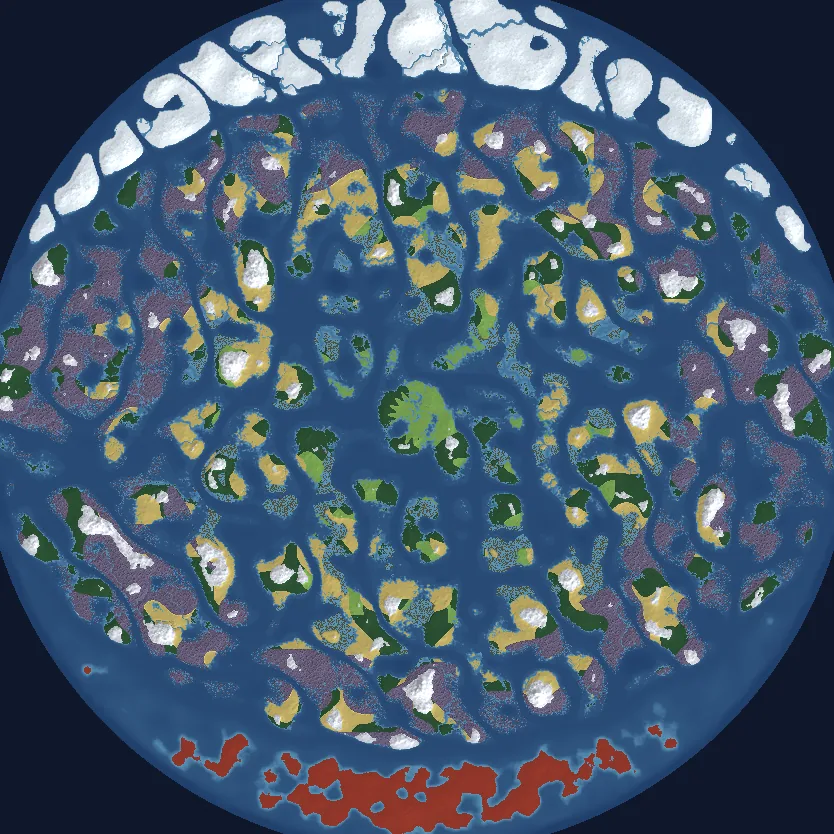
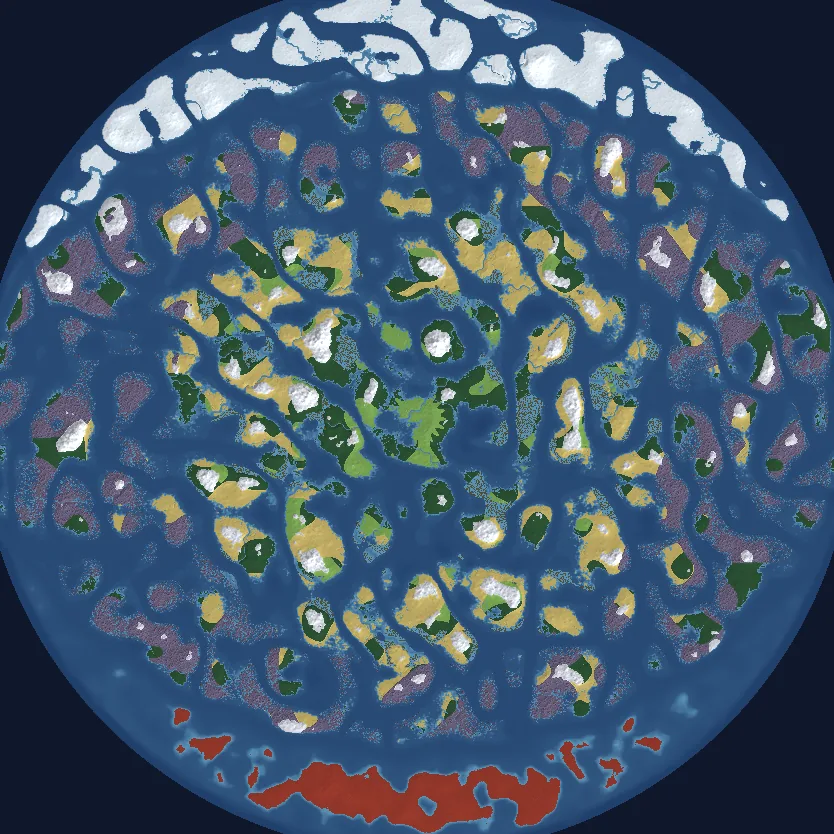
These are not redrawn or traced from another site. They come from our Valheim seed map, which runs the game's own world generator and gives the same biome and terrain height as a Valheim 1.0.17 dedicated server at every point we have compared. For this page it sampled the world every 24 metres across the whole 10 km disc, 545,436 points per world, and drew the result. Every number below is counted from those same points.
The spawn is the Sacrificial Stones, placed by the same rules the game uses. Open any seed below on the live map to see the same world with the spawn, every boss and the traders marked.
Six Seeds, Rendered
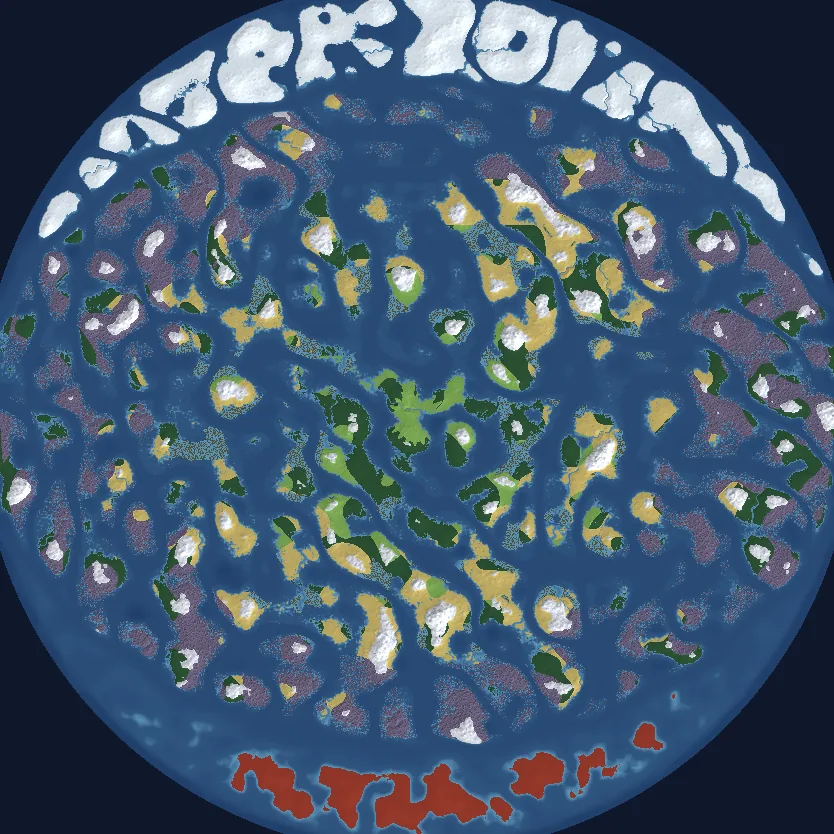
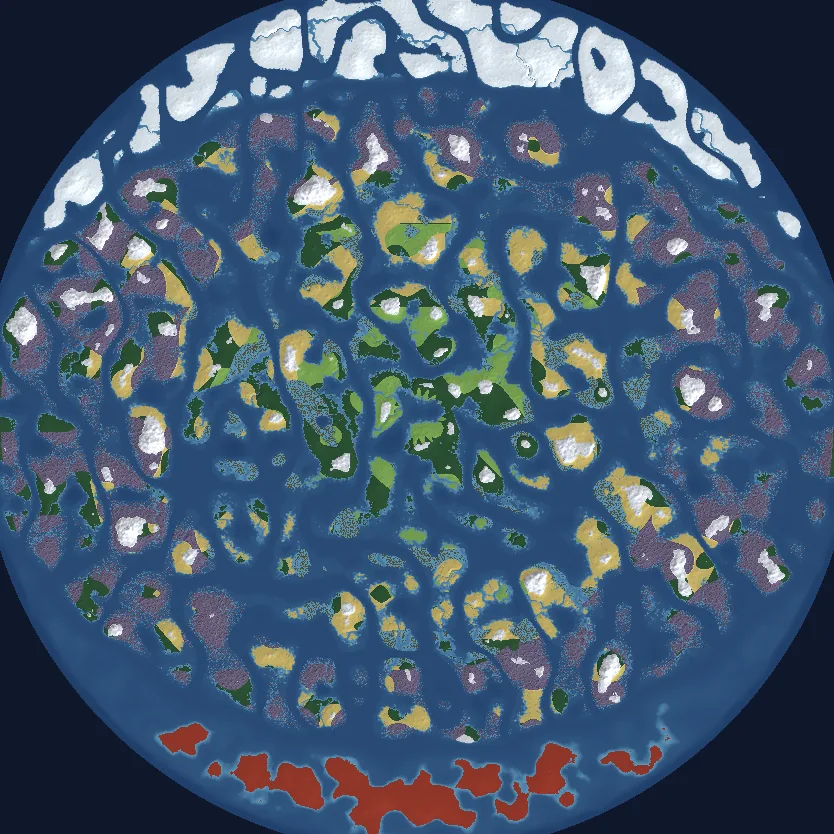
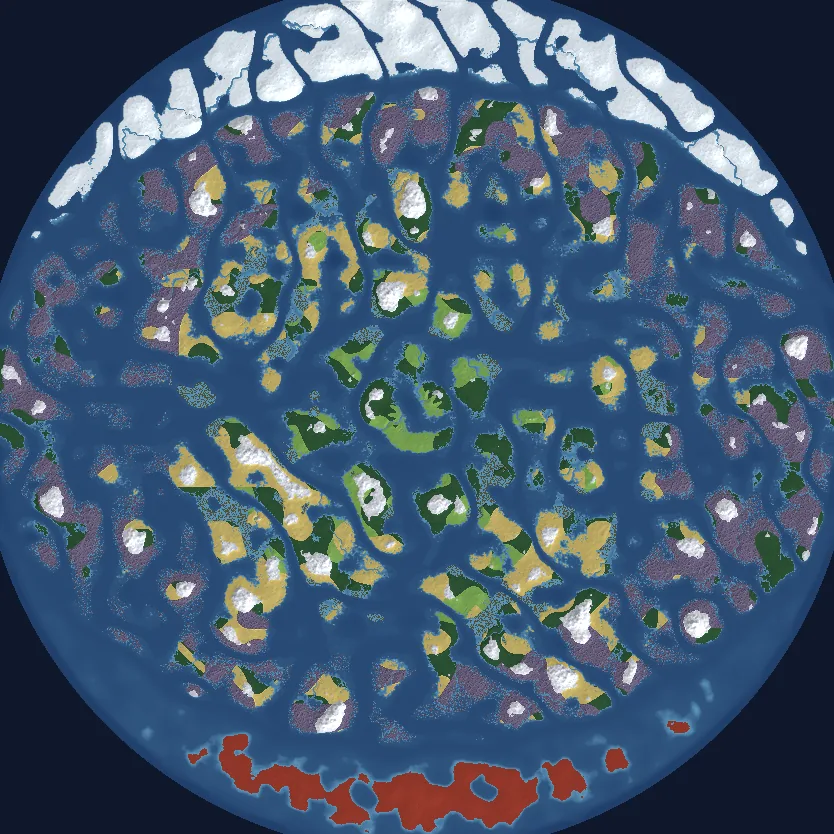
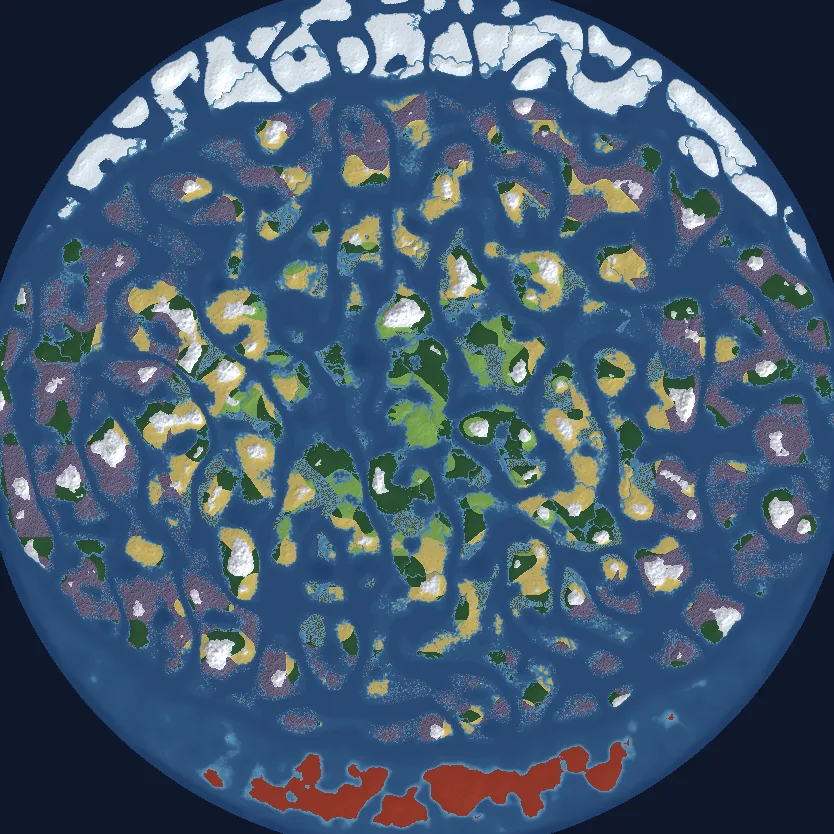
North is up. Water is blue in every biome, lighter in the shallows. Land is coloured by biome: light green Meadows, dark green Black Forest, olive Swamp, pale grey Mountain, tan Plains, purple Mistlands, white Deep North, red Ashlands. Hills are shaded, lit from the north-west.
The Numbers
Each biome column is that biome's share of the 10 km world disc, including the rivers and shallow water inside it, and for Ashlands its whole sea; Ocean is the open sea between the islands. Dry land is everything above sea level, whatever its biome.
| Seed | Dry land | Ocean | Ashlands | Mistlands | Black Forest | Plains | Deep North | Mountain | Meadows | Swamp |
|---|---|---|---|---|---|---|---|---|---|---|
| HxNkPvJq2W | 35.7% | 27.7% | 9.5% | 18.5% | 14.4% | 13.3% | 7.0% | 3.8% | 3.3% | 2.6% |
| Ylw3TqBm8R | 35.8% | 26.3% | 9.5% | 19.5% | 13.6% | 14.1% | 6.6% | 3.4% | 3.8% | 3.1% |
| Kd7ZpVnA4C | 36.5% | 26.9% | 9.5% | 19.3% | 13.6% | 14.2% | 7.1% | 3.4% | 3.4% | 2.7% |
| Mq9BsRtE6X | 35.4% | 26.2% | 9.5% | 18.4% | 14.7% | 14.9% | 6.4% | 3.5% | 3.4% | 2.9% |
| Pf2WjLhU5N | 38.7% | 24.8% | 9.5% | 18.8% | 15.0% | 14.6% | 7.1% | 3.6% | 3.3% | 3.4% |
| Tc6RyDkG3V | 35.6% | 28.1% | 9.5% | 18.0% | 14.1% | 15.3% | 6.2% | 3.2% | 3.0% | 2.6% |
Between seeds, no land biome moved by more than two points; the open ocean moved by 3.3. What does move is distance. Here is how far the nearest point of each biome was from the spawn:
| Seed | Spawn from centre | Black Forest | Mountain | Swamp | Plains | Mistlands |
|---|---|---|---|---|---|---|
| HxNkPvJq2W | 133 m | 436 m | 614 m | 1,872 m | 2,774 m | 5,784 m |
| Ylw3TqBm8R | 200 m | 312 m | 445 m | 1,807 m | 2,735 m | 5,712 m |
| Kd7ZpVnA4C | 344 m | 201 m | 390 m | 1,660 m | 2,565 m | 5,560 m |
| Mq9BsRtE6X | 63 m | 529 m | 884 m | 1,945 m | 2,839 m | 5,844 m |
| Pf2WjLhU5N | 121 m | 397 m | 663 m | 1,894 m | 2,780 m | 5,784 m |
| Tc6RyDkG3V | 3 m | 513 m | 651 m | 1,997 m | 2,898 m | 5,900 m |
These are straight-line distances to where the biome begins, which can be across water. Open a seed on the live map to see the spawn, the bosses and the traders on the same world.
What Never Changes
The maps look different, but the game files show they are all built to the same plan. Valheim decides most biomes by distance from the centre of the world, with borders that wave in and out by up to 100 m around the circle, so some things are true in every seed:
- Spawn is always Meadows near the centre. The game puts the Sacrificial Stones in Meadows, away from the biome's edge, on fairly flat ground at least 3 m above the sea, and tries the zones nearest the centre first.
- Black Forest starts 500 m to 700 m out. Inside that, the game never places it, and beyond about 5,000 m it fills whatever the other biomes leave.
- Swamp only grows between 2,000 m and 6,000 m from the centre.
- Plains run from about 3,000 m to 8,000 m, and the Mistlands from about 6,000 m to the edge at 10,000 m.
- Mountains come from terrain height, not distance, but the game keeps the ground within 600 m of the centre too low for one. The nearest Mountain was 645 m to 915 m from the centre in these six.
- Ashlands begins about 8,000 m south of the centre, Deep North about 8,000 m north. The Ashlands border depends on position alone, and the game checks for Ashlands before it checks for sea, so its sea counts as Ashlands too and the area is identical in every world. That is why it was 9.5% six times out of six. Only the land inside it changes: 2.1% to 2.6% of each world.
So seed-hunting for "less Ashlands" is pointless, and "more Plains" gets you two points at most: 13.3% to 15.3% in these six. What is genuinely worth hunting for is layout: how close your first Black Forest and Mountain are, whether your starting island is big enough to build on, and how much open water sits between you and the next landmass.
Two honest caveats
The rules above come from the game's own world generator, so they hold for every seed. The ranges between seeds, like dry land and distances from spawn, come from these six worlds only, so read them as typical rather than as limits. And the maps are measured on Valheim 1.0.17, a patch of the full 1.0 release. An earlier version of this page counted lakes and shallows as land, which put land at about 72%. If a game update changes world generation, these maps describe the build they were made on.
Using a Specific Seed
Typing a name when you create a world does not set the seed. The game fills the seed field with a random one, and a dedicated server that creates a world by itself rolls one the same way, so the same world name gives a different map every time. A rolled seed is 10 characters and never contains o, O or 1, so a seed with one of those in it was typed by someone.
To play a seed from this page, type it into the seed field when you create the world in the game, then play it or upload it to your server. A dedicated server only generates a world once, the first time it starts with that name, so the seed has to be in place before that. On a Supercraft server, enter the seed with a new world name in the server's configuration and the server creates that world for you. See how to find your world seed if you want to check what you already have.
Related Guides
- How to find your Valheim world seed
- Valheim progression: boss order and gear
- Valheim dedicated server configuration
Want to play one of these worlds with friends? Supercraft runs Valheim dedicated servers with daily backups, so the world you pick keeps running whether or not you are online.